
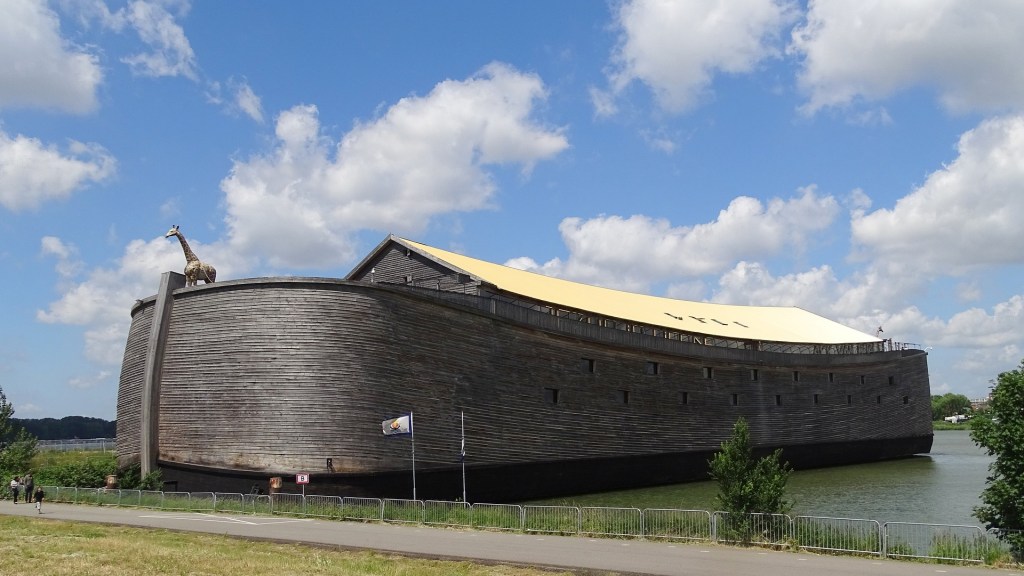
I noticed something while reading Genesis chapter 8 the other day. I haven’t yet fully formed my ideas on it which means, of course, it’s perfect material for this blog!
Leading up to Genesis 8 we have the account of how the earth was so filled with wickedness that God said “Nah” and sent a flood so devastating that all human, animal and plant life was completely destroyed except that which had been preserved on the ark that Noah built. Noah and his family spent a full year on the ark waiting for the water to recede and the land dry out before they could leave.
After Noah leaves the ark the first thing he does is build an altar and sacrifice some of every type of clean animal he had with him:
Then Noah built an altar to the Lord and took some of every clean animal and some of every clean bird and offered burnt offerings on the altar. And when the Lord smelled the pleasing aroma, the Lord said in his heart, “I will never again curse the ground because of man, for the intention of man’s heart is evil from his youth. Neither will I ever again strike down every living creature as I have done.” (Genesis 8:20-21)
Notice something? Immediately after Noah sacrifices the animals, God promises to never again do something that would kill every living thing. Which makes me wonder, what if Noah had not offered a sacrifice immediately after leaving the ark?
On second thought, let’s not consider that.
What I’m truly curious about is God’s response to what Noah did. There are many places in scripture that establish that intercession can move God’s heart to action or to refraining from action. Consider Moses’ intercession for the preservation of Israel (Exodus 32:11-14); Daniel interceding for Israel’s return to the land (Daniel 9); or Mary interceding for the life of her brother Lazarus (John 11:28-44). Typically we think of intercession as prayer; as words that consciously come out of our mouths on behalf of another. But scripture doesn’t record Noah uttering a single word as he offered his sacrifice, yet God was so moved that He promised to never again do what He had just done.
Sacrifice being a form of intercession is not something to which I had never given much thought but now I’m starting to see it more and more. Revelation 4:8 says this:
And when He had taken the scroll, the four living creatures and the twenty-four elders fell down before the Lamb, each holding a harp, and golden bowls full of incense, which are the prayers of the saints.
The intercession of the saints is again here compared to incense, or a sweet aroma, just like it is in Genesis 8. This isn’t just a few weird people in the back room of the church who like to yell and speak in tongues while all the normal people are out in the foyer enjoying coffee and other normal people before the service begins. This is a unified, sacrificial intercession from a global body of Christ that has given up their very lives for the service of the kingdom, as we see in the very next chapter of Revelation. The result? The Lamb takes the scroll and releases the seals of judgment on the earth.
Of course, the ultimate form of sacrificial intercession came in the form of Jesus on the cross. Jesus performed the greatest sacrifice by living a perfect life and yet being murdered as a common criminal, taking the wrath of God upon Himself so that we all could live reconciled to God. His sacrifice released mercy to thousands of generations; His blood pleaded for our lives and made us right before God.
What would God do in our world if we were to lay down our lives in sacrificial intercession? How much mercy and justice would God release if we, as the body of Christ, were to sacrifice what little we have and offer it back to God in gratitude for His sacrifice on the cross? Remember, Noah only had seven of each kind of clean animal and he took from such an impossibly small population and made offerings to God. The elders in Revelation 5 offered the crowns they had received from Jesus back to Him in worship earlier in chapter 4. These were costly sacrifices!
What can we offer in intercession that would cost us everything?
 Beyond The Basics
Leave a comment