
Transcript:
Welcome to the Gospel Thread Podcast. My name is Dan Snyder and I’ll be your host as we study the Bible to discover the story of the Gospel spread throughout the Scriptures from Genesis to Revelation.
That’s right. The Gospel Thread is back. Please accept my apologies that it’s been so long since I’ve been with you. Been a lot going on over the last few months. Definitely not the original plan to take about, what is it, six months between episodes. That was not my original plan and I do apologize.
And of course, for those of you who are new to the podcast, I have been at least posting old episodes from my previous podcast, Beyond The Basics, under the new Gospel Thread title. So you’ve been able to pick up on those Genesis episodes that I did a couple of years ago on my old podcast. I’ve at least been periodically posting those for some new content, for some new listeners. If you’ve been around for a while and you’ve already heard those Genesis episodes, I recognize that it’s been a while for anything new with John. And I do apologize.
We’ve, my wife and I and my family have had a lot going on. We bought a new house in June, we went on vacation in what was it? August? We moved into the new house in July and then took us a while to get kind of everything situated, get my studio set up, recording space, all that. And so it’s been a lot to kind of work around and get back to recording. I have been writing episodes over this time.
So hopefully now that life ideally has settled down just a bit, I’ll be able to get episodes out to you a little bit more often, but we all know how that goes. As soon as you say life has settled down, it has plenty more to throw at you. So that’s my goal.
So today, in this episode, we’re going to get into John 2. And this is going to be the first of Jesus’ seven signs in the book of John.
Now, of course, we see signs every day. Whether you’re driving, whether you are walking around, whether you are sometimes even just in your home. You see signs every single day.
And what do signs do? They point us to something or they encourage an action. For example, a billboard will tell us of an attraction that might be coming up. I grew up spending my summers driving to and from Northern Indiana on my vacations because that’s where my parents’ family, that’s where they were from and so we would always drive there. And I remember driving through central Wisconsin and just seeing billboard after billboard after billboard of Wisconsin Dells. If you’ve been up in that area, I’m sure you know what I’m talking about. That’s all it is. So the billboards, those billboards would tell us of an attraction, the Wisconsin Dells: It’s coming up, here’s what you need to look for, here’s where you need to go.
Another example, a yield sign is going to tell us to look for traffic before entering an intersection. So it’s encouraging an action. saying, take a look before you enter this intersection. Otherwise you could get hit. We don’t want you to be hit by another vehicle. So stop, take a look around, make sure nobody’s coming and then you can go. That’s a yield sign. So it encourages an action.
So of course the signs aren’t valuable in and of themselves. They have no value. If I were to steal a sign, a road sign, there’s no black market for signs. I wouldn’t be able to sell it and make money off of it. Maybe, you know, the random occasional guy who likes to collect signs and put it in his garage or something, you know, but that’s rare. There’s no value in those signs.
The value is in what they point to. The value of that billboard for Wisconsin Dells is in the experience that you’re going to get once you get to the Wisconsin Dells. That’s where the true value is. There’s no value in that actual billboard.
So John 2 features Jesus’ first of seven signs as well as an action by Jesus that prompts the Jews to ask for another sign. So these signs are going to serve two functions. Like I said, they point to something and they encourage an action. In this case, they point to some greater truths about Jesus, and they encourage the reader to action. So we’re going to see what this sign is going to point to and what it’s going to prompt, what type of action it’s going to prompt us to.
So let’s get into the chapter.
John chapter 2 verse 1: On the third day. Now that’s important because at the very end of the chapter, Jesus is going to talk about three days. He’s going to prophesy about the temple being raised up in three days regarding his body. So we have the third day at the very beginning of the chapter and the third day at the very end of the chapter. So that should already point us to something very important.
What pops into your mind when you think of three days in relation to the gospels? Yes. If you thought of Jesus’ death and resurrection, you would be correct. So hint, hint. Jesus’ death and resurrection is going to be very important in this chapter. We already can see on the third day it’s going to point us there.
So on the third day there was a wedding at Cana in Galilee and the mother of Jesus was there.
So moving on in verse 2, it says Jesus also was invited to the wedding with his disciples. So this indicates that this wedding was possibly for a close relative because he and his disciples were invited. His mother seemed to have some level of involvement more than just being a guest. She seemed to have some sort of administrative Involvement. So probably for a close relative or close family friend.
So then in verse 3 it says: When the wine ran out. Now wedding celebrations could last up to a week in those days in Jewish families. So the wine was supposed to last the entire week. It’s a lot of wine. These weren’t small weddings. You gotta have a lot of wine. And it would have been pretty embarrassing for the host of the wedding to run out of wine. But this particular host ran out of wine. Not a good look.
So when the wine ran out, the mother of Jesus said to him, “They have no wine.”
Now there’s no indication here that Mary expected Jesus to perform a miracle. There are a lot of speculation, which I personally disagree with, that Jesus performed miracles even as a child based on this verse; that Mary expected him to perform a miracle because she had seen him perform miracles in the past. I don’t think that’s what the text is telling us at all.
I do think the text is telling us that Jesus has shown resourcefulness in the past. And so Mary thought that Jesus may be able to do something because he is resourceful.
But all we see is that she’s asking Jesus to do something without telling him how to do it. She’s not implying anything. She’s not saying he should do a miracle. She’s not saying that he should go buy more wine. She’s just telling him, “Jesus, we have no more wine.”
So Jesus said to her, “Woman, what does this have to do with me?”
So he says, “What does this have to do with me? My hour has not yet come.”
So what is Jesus referring to here? His hour for what? Because his ministry had already begun. He already had at least four disciples. We read about them in the previous chapter. So he’s already started public ministry. But what we find, especially as we read on, is this phrase, my hour or the hour, is the author’s way of speaking about the revealing of Jesus’ glory, especially through his work on the cross.
In John 13:1 it says, Now before the feast of the Passover, when Jesus knew that his hour had come to depart out of this world to the Father, having loved his own who were in the world, he loved them to the end.
So that phrase pops up again, “his hour had come.” And in that case, Jesus knew that it was time for him to be crucified. So he knew that his hour had come. Here, he says, “My hour has not yet come.”
So of course, it’s not time for him to die. It’s not time for him to be crucified. So still, why would he say that? Why would he say, my hour has not yet come? What does that have to do with needing more wine?
Well, what he’s doing here, again, the purpose of this phrase and the way that the author uses it, it’s not necessarily to refer specifically to the cross, but it’s referring to Jesus’ glory being revealed. So Jesus’ glory is being revealed in this action in a symbolic way, similarly to a parable. He basically is telling a parable through his actions, through this miracle. And he does it quietly so that only his disciples understand which we’ll find out later on in the chapter. So he’s revealing his glory quietly, symbolically, through an action, through a miracle, through almost a living parable, rather than fully through his death and resurrection. And eventually will reveal his glory fully upon the cross.
Now some say that by saying this, “My hour has not come,” that he’s referring to his miraculous ministry. And he did not intend to be doing miracles or to begin doing miracles at this time. And Jesus changed his mind because he wanted to honor his mother. And so he started doing miracles earlier on in his ministry than he intended.
But this contradicts other statements that he makes about how he does things. Later on in chapter 5, verse 19, Jesus said to them, “Truly, truly, I say to you, the Son can do nothing of his own accord, but only what he sees the Father doing. For whatever the Father does, that the Son does likewise.”
So, Jesus tells us later on, “I do things based on what the father is doing, not based on what my mother is doing. I only do what I see my father doing.”
So, it wouldn’t make sense for him to change his mind about when he’s going to start doing miracles because either the Father has given him permission and shown him that it’s time to begin, or it’s not time to begin. It’s one or the other.
So, I think both in terms of the language that the author uses as well as Jesus’ own words, it is inconsistent to say that Jesus is referring to his miraculous ministry. I think he is referring to his glory being revealed. Here he does it quietly through a miracle. Later he will do it fully through his death and resurrection.
Verse 5. His mother said to the servants, “Do whatever he tells you.”
Again, she did not ask for a miracle. She did not imply there would be a miracle. She only implied that Jesus would know what to do. And so the servants should listen to him.
Then verse 6. Now there were six stone jars, stone water jars, there for the Jewish rites of purification. Now these were for washing hands and utensils. And these vessels stand in place of the entirety of the law. That’s essentially what they represent here. Not just the Torah, not just the first five books of the Bible, but Jewish custom as well.
In Mark 7:3-4, it says: The Pharisees and all the Jews do not eat unless they wash their hands properly, holding to the tradition of the elders, and when they come from the marketplace, they do not eat unless they wash. And there are many other traditions that they observe, such as the washing of cups and pots and copper vessels and dining couches.
So washing is very important, not just to Jewish law, but Jewish custom and tradition. So these vessels, these stone water jars, stand in place and represent Jewish law and custom. These customs and traditions are descended from laws regulating ceremonial cleanliness.
So as a result, what we can say is that because the water jars represent the Torah, and are descended from ceremonial law, that water can be a metaphor for the law or for scripture. In Ephesians 5:25-27 it says: Husbands, love your wives, as Christ loved the church and gave himself up for her, that he might sanctify her, having cleansed her by the washing of water with the word, so that he might present the church to himself in splendor, without spot or wrinkle or any such thing, that she might be holy and without blemish.
This verse here, of course, we would think of being washed clean by Jesus as being washed clean by the blood, but that’s not what this verse is saying. It’s saying that the church is washed clean by water with the Word. So it is the Word of Christ by extension.
Of course, we know that scripture is the Word of God. The Torah is the introduction of the law and the word of God to the Jewish people, passed down through the generations, making its way to the church. So, water can be used as a metaphor for the law and for the scripture. I believe that’s what it’s symbolizing here.
It says these water jars were there for Jewish rites of purification, each holding 20 or 30 gallons. And Jesus said to the servants, “Fill the jars with water.” And they filled them up to the brim.
Which symbolizes Jewish ceremonial law had reached its fullness. Again, that water represents the law, the tradition, Jewish tradition, and it is being filled up to the brim. Can’t fill it up even more. So Jewish ceremonial law had reached its fullness.
What does that mean that it’s reached its fullness? Not that it is done away with, but that Jesus has come to fulfill the law. We see that in many other places in the Gospels. Matthew 5, Jesus says, “I didn’t come to do away with the law, but to fulfill it and not one iota will pass away.”
The fullness of the law doesn’t mean that it’s being done away with. The fullness of the law means that it could go no further and Jesus has come. Someone needed to fulfill the law. Someone needed to keep the law to its fullness. Nobody had done that yet. Jesus is now here to keep the law in its fullness.
And then he says in verse 8, he says, “Now draw some out and take it to the master of the feast.”
Now this is commonly thought to be drawn from the jars, draw water out of the jars, but, and it seems on a natural reading that that would be the correct procedure. However, it’s more likely that this water was drawn from the well. And that would be to preserve the symbolism of the filled jars so that the jars stay filled. They take water from the wells instead.
But even if Jesus is not instructing them to take water from the wells, even if he’s instructing them to take water out of the jars so that they’re no longer filled, the symbolism is still significant because Jesus’ death, which this is pointing to, does not invalidate the law, like I said, but it fulfills the law. Jesus’ life by keeping the law fulfills the law and his death fulfills the law. By, of course, all the symbolism of the two goats, the offerings. There’s more than we could ever get into right now. One day when we get into Leviticus, we will go through all that symbolism.
But Jesus’ death fulfills the law just as much as his life fulfills the law. The reason why I say that is because, of course, what’s about to happen is they’re taking water from these jars, these jars symbolizing ceremonial cleanliness, symbolizing the law. They’re taking water, symbolizing the Torah, and taking it out and turning it to wine, which symbolizes Jesus’ death. So that symbolism there is that all these laws all point to one thing, the death of the one who fulfilled the law.
So Jesus tells them to take some out, take it to the master of the feast, and so they took it. The servants obeyed Jesus immediately and completely. They did not question him. They did what he said, what he told them to do.
Verse 9: When the master of the feast tasted the water now become wine, and did not know where it came from.
The water had become wine, which bypassed the human effort involved in making wine. Which of course that effort, that procedure is the harvesting of the grapes, the pressing and the fermentation. All that is bypassed. It goes from water directly to wine.
And it says, he did not know where it came from, (though the servants who had drawn the water knew), the master of the feast called the bridegroom.
The master of the feast called the bridegroom, verse 10, and said to him, “Everyone serves the good wine first, and when the people have drunk freely, then the poor wine. But you have kept the good wine until now.”
So, of course, as I’ve mentioned, wine is a symbol of Jesus’ blood and the new covenant. The good wine symbolizes the new covenant being the better covenant. Better, of course, than the old covenant. The covenant given at Mount Sinai to Israel, the Old Covenant of course being the law.
Once again, Jesus came not to do away with the old because the jars were still there, but to fulfill it by bringing in the new. This is essential for Christians to understand. And I think so many Christians miss this point. It is very important. The New Covenant does not replace the Old Covenant. The New Covenant fulfills the Old Covenant. The Old Covenant still stands, fulfilled by the New Covenant.
We as Christians, especially as Gentile Christians, or even as Gentile Christians, can still claim descent from the Old Covenant. We are still brought in to the Old Covenant by way of the New Covenant.
Because what is the purpose of the Old Covenant? The purpose was, yes, to give a law to govern the nation. Yes, to highlight the need of Israel for a redeemer. But also to be betrothed to essentially marry Israel to God. There are many purposes there, but that new covenant, it fulfills the purpose of the Old Covenant to bring unity between God and His people.
The Old Covenant could not accomplish it, but the Old Covenant was there stating its purpose, to bring unity to God and His people. That’s why God gave the Old Covenant. It was an invitation to the nation of Israel to say, “You will be our God and we will be your people.” And they failed at it over and over and over again.
But the New Covenant, it does not invalidate, it does not do away with the Old Covenant. It simply says, the Old Covenant is now fulfilled. There is now a way to become unified with God, and it’s through Jesus Christ. We can now be God’s people, and He can now be our God through Jesus Christ.
I like to think of it as two halves of one covenant. A lot of Christians, and I’ve seen this, I’ve talked to people that will do this, will create a clear dividing line between the old and the new covenant. And I just don’t think that’s helpful. They will say anything before the cross is old covenant, anything after the cross is new covenant.
Not only are there a lot of blurred lines there that aren’t as clear as many people will make it out to be. But I don’t think it’s helpful in truly understanding the two covenants. I think it’s more helpful, at least for me, to think of it as two halves of the same covenant.
The old was incomplete. The old covenant is completed in the new covenant. We can now fully keep the old covenant because we now have the New Covenant. Hopefully that makes sense. Hopefully that helps kind of clarify a little bit of your thinking on the Old and New Covenant, but I believe that that’s what the symbolism is here saying. I believe that that is what this chapter is trying to point us to.
Moving on in verse 11. This, the first of his signs.
So all of Jesus’ miracles in this book serve a purpose to point to something greater, like I mentioned at the beginning of this episode. That’s how they were intended to be interpreted by those who witnessed them, and that’s how we should interpret them as modern readers.
So, as we go through this book, as we see these signs, they all serve a purpose to point to something greater. They are not signs just to show Jesus as a powerful prophet. These signs do not exist just to show Jesus as showing us an example of how we should live. That’s not the purpose of the signs. It’s to point to something greater. It’s to point us and reveal something about Jesus himself, about his mission, about his identity. That’s what we need to keep in mind when we read these signs.
So many people read these signs, they read this book of John, and they say, “Well, Jesus did it, therefore we should do it too.”
Now, I definitely agree that God will do miracles in these days. Now, still, today. I’ve seen them. I’ve prayed for a woman who was blind and she received her sight. God does miracles today.
But we should not have the expectation that just because Jesus healed everyone that he encountered or just because Jesus did all these miracles, that it should be a common, everyday, constant occurrence in our lives. Because the reason it is portrayed as common in the Gospels and especially in the book of John is because they were signs that were intended to point to a specific aspect of Jesus’ identity and mission. And we need to keep that in mind as we read.
Moving on in verse 11, this, the first of his signs, Jesus did at Cana in Galilee, and manifested his glory.
This is the purpose of the signs, to reveal his glory.
Now this in particular is a miracle of compassion. This reveals Jesus as compassionate, because the only thing at stake was the reputation of the bride and groom. Nobody was going to be hurt. Nobody was going to die. There was not even a sin issue to address. The only thing that was going to be hurt was the reputation of the bride and groom. But that was enough for Jesus. He was compassionate. He had compassion on this bride and groom. And so he did the miracle.
And then at the end of verse 11 it says: His disciples believed in him.
Now this is the intended result of the signs and the ultimate purpose of the book. We see that even at the end. The purpose of the book is that we may believe. So the disciples believed, those who already had faith saw that their faith was deepened.
The disciples had faith already, their faith was deepened, but we’re not told that anyone else believed as result of this miracle. Those who had faith already received deeper faith. But no one who did not have faith received faith. No one who did not believe suddenly believed as a result of this miracle. At least we’re not told that.
But we will find that that is many times the case when Jesus does a sign. That those who believe already will be affirmed and deepened in their belief. Those who do not believe will be affirmed and deepened in their unbelief. This is many times a result of Jesus’ actions.
And really, it’s the reason why he came, because it forces people to make a decision. We are all forced to make a decision. I’ve talked about this many times on this podcast. But we are all forced to make a decision when we encounter Jesus and His actions and His words. We must make a decision. We don’t want to be like those who don’t believe and dig in their heels deeper and deeper in their unbelief.
If you are listening and you don’t believe, you have a choice right now. Not saying that you have to make the choice right now and forever hold your peace. I believe, I believe Jesus pursues us over and over and over. He gives us many chances to choose Him. But don’t take your chances. If you’re listening to this now and you don’t believe, choose. Choose today to believe. Read the words before you on this page in this book. See who Jesus is. See His compassion. See His care. And see His glory and believe and follow. Choose to become one of his disciples. That’s the whole purpose of any of these signs, ultimately, is that we would believe.
Verse 12, after this he went down to Capernaum with his mother and his brothers.
Let’s talk about the sign of the water turned into wine. What’s the purpose?
Of course, wine represents Jesus’ blood. The law had reached his fullness. Like I said, it was inadequate to cleanse people of their sin. It was good. The law was good. The law was right. But it was inadequate. It was incomplete. It needed to be fulfilled by someone. Jesus’ blood will be poured out, which we will read about later on in the book, of course, and on the third day would fulfill the law. This ultimate sign, the ultimate sign of the cross, would result in a new covenant that came after the old, that came from the old, and that is better than the old. Yes, they are two halves of the same covenant, but the second half is better.
But it’s not enough to understand that the New Covenant came after the Old. We also must understand that the New Covenant came from the Old. The sign of the water turned to wine occurs at a wedding, which is a picture of the relationship between Christ and the Church. I talked about this a little bit already.
The Old Covenant was like a betrothal. It was an invitation from God to the nation of Israel. And now the New Covenant is like the wedding. Ephesians 5:25-32 says: Love your wives, as Christ loved the church and gave himself up for her.
I read that verse already. But later on, Paul says: No one ever hated his own flesh, but nourishes it and cherishes it, just as Christ does the church, because we are members of his body. “Therefore, a man shall leave his father and mother and hold fast to his wife, and the two shall become one flesh.” This mystery is profound, and I am saying that it refers to Christ and the church.
We become one. We become united with Christ through the New Covenant, through his work on the cross, his death and resurrection. This is the nature of the New Covenant and that’s why it took place at a wedding. That’s why this sign took place at a wedding because it points to the nature of that New Covenant. The unity that believers enter into through the covenant with Jesus Christ and ultimately with God, is reflected, that unity is reflected in earthly marriage. That is what it is intended to look like. That is the deep level of unity that we should experience with Christ. So that’s the purpose of the sign of the water turned to wine.
So now we’re going to get into the cleansing of the temple.
In verse 13, the Passover of the Jews was at hand and Jesus went up to Jerusalem.
Verse 14: In the temple he found those who were selling oxen and sheep and pigeons.
So in the temple, he would be in the outer court, which is the only place Gentiles could come to worship. And all this activity here would, of course, make it impossible for Gentiles to worship because there’s people selling animals everywhere. These oxen and sheep and pigeons were all typical animals used for sacrifices. They were likely being sold for people to purchase so they could make their sacrifices.
Of course, not everyone owned the required animals. They would have to purchase them. That’s the purpose here of the money changers sitting there that we see in verse 14. Not everybody owned animals that were required by the law.
So you could buy them in your hometown and bring them all the way to Jerusalem to make your sacrifice. Or you could travel to Jerusalem and then buy the animal there. Much easier, right? You don’t have to worry about feeding the animal on the way over on the journey.
So the most convenient place, of course, to purchase these animals was at the temple itself. Seems pretty logical. If you go, if you need an animal for sacrifice and you don’t have it, where’s the best place to buy it? At the place where you need to make the sacrifice anyway. It’s logical for the seller. It’s logical for the buyer. It makes sense.
In addition, Jews would come from other nations and regions, not just in Israel, but all over the Roman world. And they would need to exchange currency for the temple tax because of course most people in Rome and in the Roman Empire would have Roman currency, but the temple tax would need to be made in Jewish currency. So they would need to exchange that currency. So that’s why we have money changers.
So we’ve got all this activity. Imagine this activity going on. Animals everywhere. People selling animals everywhere. Money changers, exchanging currency, all while people are trying to worship. This is the only place Gentiles could go to worship, is in the outer courts where all this activity is happening. How are Gentiles who believe in the God of Israel supposed to come and worship when all this is going on?
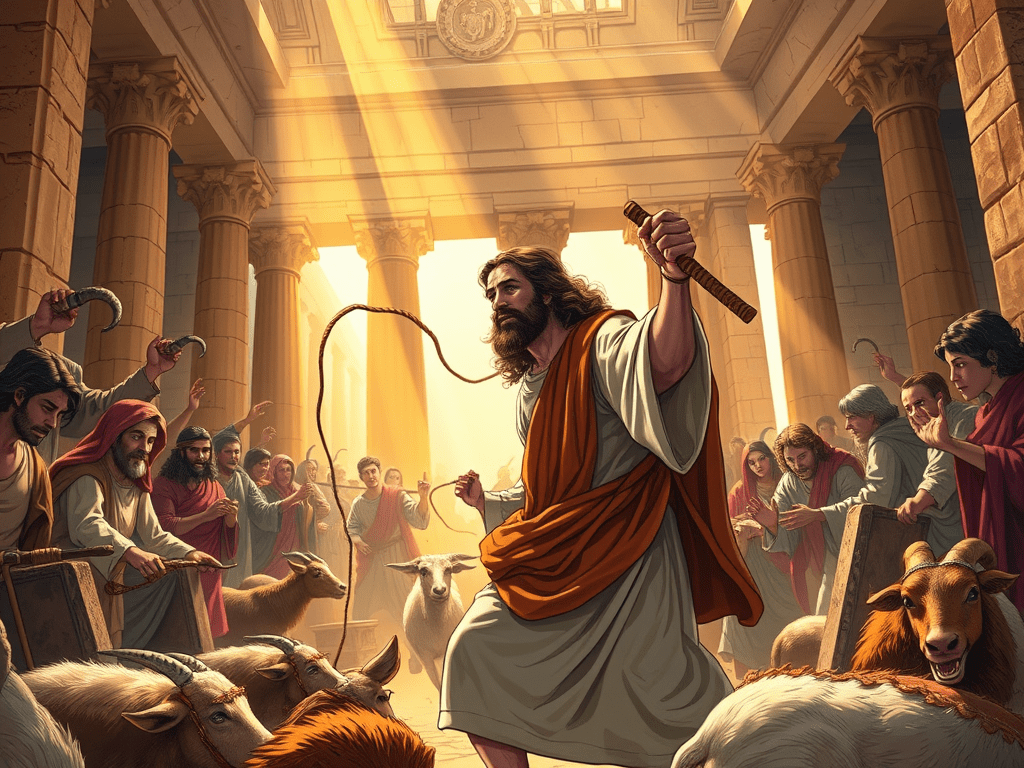
So what does Jesus do? In verse 15, making a whip of cords, which typically would be used for driving or herding animals. It’s not a whip intended for harming humans. Okay, so don’t get the wrong idea. Jesus is not making the same type of whip that would later be used to rip his back to shreds before he goes up on the cross. He is making a whip used for herding animals. This is not intended for harm. This is intended to move large quantities of animal and human life out of a place.
So making a whip of cords, he drove them all out of the temple, with the sheep and oxen. And he poured out the coins of the money-changers and overturned their tables, which communicates the message that their money is worthless.
And he told those who sold the pigeons, “Take these things away; do not make my father’s house a house of trade.”
Now, you might notice that this event is similar to another one and you might even think that it’s the same one in the book of Matthew but I believe it is a separate event and the reason here is because there are two different issues in the two accounts. The one in Matthew chapter 21 verse 13 he said to them, “It is written, ‘My house shall be called a house of prayer,’ but you make it a den of robbers.”
Here he says, “Do not make my father’s house a house of trade.”
Two different issues. One, Jesus is talking about the robbing of the people, or the plundering of the people in the house of prayer. Here, he’s talking about making a house of worship into a house of trade or a house of merchandise. So two different issues, I believe this is two different cleansings.
Now, Jesus completes the cleansing of the temple, and there are two prophetic acts in the Old Testament that I believe point to this.
Malachi 3:1-4 says, “Behold, I send my messenger, and he will prepare the way before me. And the Lord whom you seek will suddenly come to his temple; and the messenger of the covenant in whom you delight, behold, he is coming, says the Lord of hosts. But who can endure the day of his coming, and who can stand when he appears? For he is like a refiner’s fire and like a fuller’s soap. He will sit as a refiner and purifier of silver, and he will purify the sons of Levi and refine them like gold and silver, and they will bring offerings in righteousness to the Lord. Then the offering of Judah and Jerusalem will be pleasing to the Lord as in the days of old and as in former years.”
Now, in order to see that I believe this section in Malachi is referring to this particular action, we have to both take into account John chapter 1 and chapter 2 because this cleansing of the temple takes place one chapter after seeing the messenger, John the Baptist, preparing the way. So Malachi 1 mentions the messenger who will prepare the way, John the Baptist. Now we see the Lord coming suddenly to his temple. He is the messenger of the covenant, which we just read about the new covenant. He is purifying the priesthood, purifying the temple, refining them.
This is a prophetic act looking toward a day when Israel will worship with a pure heart. It is very clear that the author of this gospel has strung these events, John the Baptist, the wedding at Cana, the water turned to wine, and the cleansing of the temple together. He has strung these three events together to point directly back to Malachi and his prophecy.
And what is that prophecy referring to? What is the ultimate result of that prophecy? It’s the worship, the pure righteous worship of Israel in the city of Jerusalem and in the temple. This is a prophetic act looking toward the day when Israel will worship in righteousness and in purity.
So that’s half of it.
The other prophetic act, Zechariah 14:16-21. Then everyone who survives of all the nations that have come against Jerusalem shall go up year after year to worship the King, the Lord of hosts, and to keep the Feasts of Booths. And if any of the families of the earth do not go up to Jerusalem to worship the King, the Lord of hosts, there will be no rain on them. And if the family of Egypt does not go up and present themselves, then on them there shall be no rain; there shall be the plague with which the Lord afflicts the nations that do not go up to keep the Feasts of Booths. This shall be the punishment to Egypt and the punishment to all the nations that do not go up to keep the feasts of booths. And on that day there shall be inscribed on the bells of the horses, “Holy to the Lord.” And the pots in the house of the Lord shall be as the bowls before the altar. And every pot in Jerusalem and Judah shall be holy to the Lord of hosts, so that all whose sacrifice may come and take of them and boil the meat of the sacrifice in them. And there shall no longer be a traitor in the house of the Lord of hosts that day.
I read all of that to show that this is talking about the Gentiles and the Gentiles coming to Jerusalem to worship. And in verse 21 of that section, Zechariah prophesies that there will not be any traitors in the temple, preceded of course by verses referring to the Gentiles coming to Jerusalem to worship. Now this prophecy takes place during the earthly reign of Jesus after his return.
So once again, we have Gentiles coming to worship. We have traders in the house of the Lord, Jesus in the Father’s house. There are traders, there are merchants, and Jesus kicks them all out. He drives them all out so that the Gentiles can come worship. This is a prophetic act looking toward a day when Gentiles will worship in the house of the Lord.
So we have two prophetic acts, two halves, a prophetic act looking toward the day when Israel will worship and a prophetic act looking toward a day when Gentiles will worship.
In verse 17, his disciples remembered that it was written, “Zeal for your house will consume me.”
Once again, his disciples were the only ones who recognized the sign and the disciples of course will have their problems later, but for now I’d say they’re off to a good start. They’re believing, they’re remembering, they’re doing well so far.
So they remember it was written, “Zeal for your house will consume me.” This is a quote from Psalm 69:9.
In verse 18, the Jews said to him, “What sign do you show us for doing these things?”
The Jews, of course, that were just driven out, now they turn to Jesus and they say, “What sign do you show us that you would do these things?”
So we’re beginning to see the blindness of the Jews. They asked for a sign of his authority to clear out the temple when what he had just done was the sign. I just talked about those two prophetic acts or the references to the prophecies in the Old Testament. The disciples recognized it. They recognized his authority and they recognized exactly what he was doing. They remembered the words of the psalmist, the author of the gospel, which I believe is the disciple John, clearly remembered these other prophecies in the Old Testament in Zechariah and in Malachi as he was writing and intended us to remember those prophecies as we read.
So the disciples saw, why couldn’t the Jewish leadership see? This is the same exact question Pharaoh asked Moses in Exodus 7:9. It says, “When Pharaoh says to you, ‘Prove yourselves by working a miracle,’ then you shall say to Aaron, ‘Take your staff and cast it down before Pharaoh that it may become a serpent.’”
So Pharaoh would say to Moses, “Prove yourself. Show me a sign. What’s your authority? What authority do you have? Show me a sign that proves your authority.”
That’s exactly what Pharaoh said to Moses. That’s exactly what the Jews are saying to Jesus. So it’s showing the Jews as hard-hearted, that the Jews were as hard-hearted as Pharaoh.
Verse 19, Jesus answered them, “Destroy this temple, and in three days I will raise it up.”
And the sense here is that he’s saying is more like, “Find out what happens when you destroy this temple. You’ll see, you’ll see what’s going to happen when you destroy this temple.”
And he says, “I’ll raise it up in three days.”
So the resurrection, that’s the ultimate sign. I think about this sometimes that Jesus, he says, “Greater works than these will you do.”
And, you know, me coming from a background of the Charismatic Church, a lot of people would always interpret that as saying, well, we can do greater miracles than Jesus did. We can do greater signs. We can perform greater signs than Jesus did because he says, “Greater things will you do.”
That’s not what he’s talking about. And here’s why. Because the resurrection is the ultimate sign, the ultimate miracle. You cannot get greater than that. No one has ever resurrected himself. Not before and not after. And even the few who have been raised from the dead eventually died again. Jesus is the only one who resurrected himself and stayed alive. That is the greatest work. That is the greatest miracle. That is the greatest sign, the resurrection of Jesus Christ. There is nothing greater. It’s the ultimate sign.
So that’s what Jesus was telling them, saying, “Okay, you want a sign? Why don’t you find out what happens when you destroy this temple? I’m going to raise it up. That’s your sign.”
And the author, of course, adds his, he goes on to tell us that the Jews then said, “It has taken forty-six years to build this temple and will you raise it up in three days?”
And then the author adds his commentary. He says, but he was speaking about the temple of his body. Of course, the temple is where God’s presence dwelt. So the temple is not about a building, but it’s about where God dwells. This is very important.
That’s why we can be called the temple, because God’s presence now dwells in us through his Holy Spirit. God dwelt in Jesus. The Holy Spirit dwells in us. We are the temple. The temple is where God dwells. God dwelled in the temple in the Old Testament, or in the Old Covenant. Now, in the New Covenant, God dwells among his people, in his people.
Verse 22: When therefore he was raised from the dead, his disciples remembered that he had said this, and they believed the scripture and the word that Jesus had spoken.
And they believe not just because Jesus had foretold his death and resurrection, but because the scripture also foretold it, including the events in this chapter. This is very important. Very, very important. If all we had was accounts of Jesus dying and being resurrected, it wouldn’t be enough. We had to have the scriptures foretelling it. That’s how we know that it’s the work of God and it’s the ultimate proof that the resurrection took place.
Many, many people will acknowledge the existence of Jesus. Many, many people will acknowledge the death of Jesus. Very few will acknowledge the resurrection of Jesus. And they will claim that it’s because there is no proof. But there is proof. It’s in the scriptures. It was written down thousands of years beforehand, before it happened. If it weren’t in the Old Testament, we would have no proof that the resurrection actually happened. We know it happened because it was foretold. And the disciples recognized it after it happened. They believed because it had been foretold.
We must believe. We can believe because it had been foretold. We have the record of scripture. We have the prophecies. We can see that the prophets were true because Jesus fulfilled the Old Covenant.
So what is the purpose of the cleansing of the temple? It’s a prophetic act to draw attention to the defilement of worship for both Gentiles and Jews and Jesus’ zeal to cleanse that defilement. And ultimately the defilement is only going to be cleansed with Jesus’ death and resurrection. That death and resurrection was foretold. The results of his death and resurrection are also foretold in the ability for both Jews and Gentiles to come worship in both righteousness and purity and in unity with Christ.
So now we have a little bit of a tag on this chapter, a couple verses here, three verses that says: Now when he was in Jerusalem at the Passover Feast, many believed in his name when they saw the signs that he was doing.
So Jesus has now performed two signs, many believed when they saw these signs. That’s contrasted with the disciples who believe before they saw the signs. This is very important.
This is going to be a theme that we’re going to notice throughout the book. The disciples believed before they saw the signs. Many believe without signs. We’ll see in chapter 4 that there’s going to be Samaritans that believe without signs. Many Jews believe when they see the signs. Their belief is going to be superficial and in fact, we’re going to find out that by the end of the book many that believed in the signs will turn on Jesus later on. This emphasizes that signs are a recipe for disaster. We must be like the disciples and believe in who Jesus is rather than what he can do for us.
I am telling you, I’ve seen it way too often. I’ve seen it too much. People, especially coming from the Charismatic Church, people who chase after signs, their faith is skin deep. It does not run deep. They encounter difficulties, encounter disappointment, they encounter trauma, they encounter disaster, and it wrecks their faith.
We cannot rely on signs. We cannot insist that we must be doing signs to spread the gospel. We can’t rely on signs. Signs are only to point to one thing.
Remember what I said at the beginning of this episode? There is zero value in the sign. The value is in what the sign points to. The value is in Jesus Christ. Who He is, why He came, and why He’s coming back. There is the value, not in the sign itself. We must believe in who Jesus is, not what He can do.
In verse 24, it says, Jesus on His part did not entrust Himself to them, because He knew all people and needed no one to bear witness about man, for he himself knew what was in man.
Alright, so we got through chapter two. What is the gospel thread? The gospel that is threaded all the way through from the Old Testament through to the New Testament. That’s the final or ending segment here in the New Gospel Thread podcast, of course. Every episode, we’re going to talk about how the gospel is threaded throughout the Old Testament into the New.
So there are parallels between these two narratives here, and they tie into the Old Testament. I’m going to show you how.
We have parallels first between the two narratives, both referred to the third day. I mentioned that at the beginning of the episode, the wedding occurred on the third day and Jesus foretold his resurrection on the third day. Both involved a week long feast. Weddings, like I said, often lasted a week. The Passover celebration lasted a week.
Both involved a symbol of the Torah merged with tradition, the jars that were used for ritual purification and the money changers in the temple. Those were both symbols of the Torah merged with tradition. Of course the jars symbolizing the ceremonial laws, money changers symbolizing selling the animals, the money for the temple tax for the sacrificial laws. Both involved a symbol of cleansing the jars, again used for purification and the clearing of the defiling practices in the temple.
Both involved a sign. The water turned to wine was the first sign done by Jesus and in the second Jesus gave the Jews the sign of his resurrection after cleansing the temple. Both resulted in the disciples increased belief in Cana immediately and in Jerusalem after Jesus’ resurrection.
We have the geographical setting. Jesus went down after the wine was poured out and Jesus went up before giving the sign of his resurrection.
So what do these parallels show us?
They show us that these two narratives are making the exact same point. That Jesus’ death and resurrection on the third day will institute a new covenant, one that is better than the first. One that, like I said, came from the first, came out of the first, and is better than the first. It will result in the cleansing of both Jew and Gentile. And this is important considering John’s audience, of course, because he had both Jew and Gentile readers.
It will fulfill God’s purpose in creation, which is symbolized through the wedding and his God’s purpose in the law, symbolized in the Passover. And his purpose is, of course, God dwelling with his people.
All these points, all these purposes are all pointing back to the beginning, both the beginning of creation. Why did God create humanity in the first place? Why did God give them a garden? Why did God give them a chance to the deep intimacy and the relationship between God and man in the garden? How he would walk with Adam every day. That’s God’s purpose in creation. Communion with God.
And of course, Adam ate of the fruit. Humanity fell and was removed by God from the garden removed from God’s presence. The garden in itself is the original temple even, and so ever since the garden we’ve been separated from God’s presence and the temple was the one way we could come even approach and worship.
Now this chapter is pointing to the way that worship will be restored, that communion will be restored through the cross, through Jesus’ work on the cross. We can now have communion with God because of what Jesus did, because of the new covenant. We can now approach and remain in God’s presence, just like in the Garden of Eden.
Now wine, of course, was a symbol in the Old Testament of the abundance in the New Eden. Joel 3:17-18 says, “So you shall know that I am the Lord your God, who dwells in Zion, my holy mountain. And Jerusalem shall be holy, and strangers shall never again pass through it. And in that day the mountains shall drip sweet wine, and the hills shall flow with milk, and all the stream beds of Judah shall flow with water; and a fountain shall come forth from the house of the Lord and water the valley of Shittim.”
So that verse is presenting an image of a new Eden. It’s an image of abundance and beauty and that image of mountains dripping sweet wine is included in that image of New Eden. There are many such passages throughout the prophets that speak of wine in a context of New Eden in the same way.
Melchizedek in Genesis chapter 14 brought out bread and wine to symbolize the New Covenant. So this goes all the way back. This goes all the way back to Melchizedek. This new covenant was symbolized all the way back in Genesis 14. Melchizedek brought out the bread and the wine to Abraham, who then gave of his own goods to tithe to Melchizedek.
And then the ruler from the line of Judah in Genesis 49 would be covered in wine, symbolizing blood. Verses 10 through 12 of Genesis 49, says, “The scepter shall not depart from Judah, nor the ruler’s staff from between his feet, until tribute comes to him; and to him shall be the obedience of the peoples. Binding his foal to the vine and his donkey’s colt to the choice vine, he has washed his garments in wine and his vesture in the blood of grapes. His eyes are darker than wine, and his teeth whiter than milk.”
Imagine what it would look like if somebody washed their garments in wine. It would all be stained red, of course. That’s kind of an image of this ruler from Judah being covered in red. Of course, Jesus would be covered in blood as he has poured out all his blood to the last drop for us.
Wine throughout the Old Testament symbolizes both the New Covenant and the result of the New Covenant, which is a New Eden. It’s all over the Old Testament. I could go on for hours with all the references. I’m not going to. You can certainly feel free to look up more references on your own if you would like.
So with that said, I have a question for reflection for you for this particular episode.
My question is this: What do you think is the difference between the disciples’ belief and the many who believed in verse 23? And what can you learn about your own belief from this? Both from the difference and just in general from this chapter, what can you learn about your own belief in Jesus and who he is?
Well, thank you for listening. Once again, I’m sorry it took so long to get this episode out. I do hope to have episodes out on a more regular basis, but I encourage you, if you like what you hear, please click like, click subscribe, click, you know, rate the show, leave a comment.
If you want my show notes, I have my blog where I post these episodes as well, along with the show notes and a transcript, beyondthebasics.blog. You can get the show notes there. Click on the episode and then you can download the show notes. Do that. Leave me a comment there. Leave me a comment on whatever you’re listening to. You know, again, click like, click subscribe. My goal is of course to reach as many people as I can with the gospel. That is a great way to help increase the reach of the show so that more people can hopefully hear the gospel and respond.
Also, if you want to help support the show, you can become a member on Patreon. It’s $4 per month. You’ll receive early access to episodes. I publish them on Patreon as soon as they’re done editing, as soon as they’re done being edited. Rather than waiting for specific, especially once I get in a more regular cadence, I will designate a certain Sunday of the month or a certain day of the week to release episodes. Well, if you’re on Patreon you get them as soon as they’re done being edited. So you get them a lot sooner.
Also, I cut out a lot of content from these episodes. The uncut episode goes on Patreon. So you typically get another 15 to 20 minutes of content; a lot of background information a lot of extra stuff in those Patreon episodes that you don’t get in the free show.
As well as you get the opportunity to vote for the next book of the Bible that we study. So if you want to have a say in what we study next after we finish up John, go sign up for Patreon for $4 a month and you’ll be able to vote on that.
So whether you do or don’t, I always appreciate that you have joined me for this study. Thank you for listening and I look forward to talking to you on the next episode.
Sources:
Mounce, R. H. (2007). The Expositor’s Bible Commentary: John. Zondervan.
Bruce, F. F. (1983). The Gospel of John: A Verse-By-Verse Exposition. Kingsley Books.
Guzik, D. (2024). John 2 – Conversion and Cleansing. Enduring Word. https://enduringword.com/bible-commentary/john-2/
Mingcong, C. (n.d.). Did Mary Mother of God Give Birth to Other Children?. Ask Fr Francis. https://askfrfrancis.org/qa/did-mary-mother-of-god-give-birth-to-other-children
Armstrong, S. (2014, September 25). Gospel of John – Lesson 2. Verse By Verse Ministry International. https://versebyverseministry.org/lessons/gospel-of-john-lesson-2
Music:
Def Lev – “Ain’t No Mercy Here”
Rockin’ For Decades – “Step On Up”
Grevins Tid – “Hanged Drawn & Quartered (For Rock n’ Roll) (Instrumental Version)”
Mizio – “Fragments”
The Fly Guy Five – “Birthday-Bash”
Rockin’ For Decades – “Enough This Time”
 Beyond The Basics
Leave a comment