
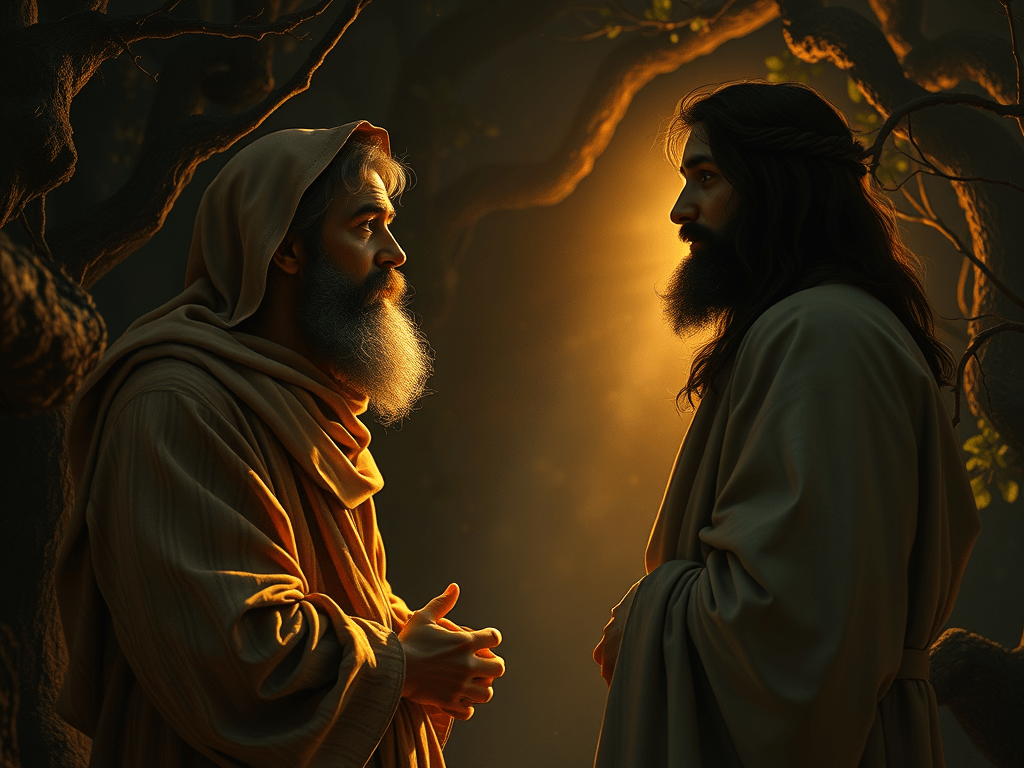
Transcript:
Welcome to the Gospel Thread Podcast. My name is Dan Snyder and I’ll be your host as we study the Bible to discover the story of the Gospel spread throughout the Scriptures from Genesis to Revelation.
What do you think of when you hear the word believe?
Maybe you think of aliens. Maybe you’re like me and you think of Sasquatch. Maybe you love music and you think of Cher or Journey. All kinds of things that we think of when we hear the word believe.
What does it mean to believe? What is belief?
Well, there’s got to be an object of our belief. We can’t just believe in nothing. We have to believe in something. There must be an object.
So depending on what that object is, that will determine how we respond. For example, if you believe in aliens, that might cause you to listen to George Noory. Is George Noory still a thing? I don’t know. I used to listen to him back in the day, 20 years ago. He was a goofball. I don’t know if he’s still around or not. If he is, let me know. But if you believe in aliens, you might listen to George Noory on Coast to Coast AM and start preparing for the impending alien invasion, among other things that George used to talk about.
If you believe in something, you’re going to respond. You’re going to do something about it. And we see that theme here in the book of John.
We’ve already seen two different types of belief as we’ve gone through the first two chapters of John. We’ve seen the belief of the disciples and we’ve seen the belief of the many. The disciples believe because of Jesus’ words. The multitudes believe because of Jesus’ signs. So there’s two different types of belief. And now in John chapter 3, we’re going to see two more meditations on belief.
So let’s get into the chapter.
First, of course, this is the famous conversation between Jesus and Nicodemus. And then after that, we’ve got insight into John the Baptist’s ministry.
Verse 1 says: Now there was a man of the Pharisees named Nicodemus, a ruler of the Jews.
In verse 2 it says: This man came to Jesus. And he came as a representative of the many at the end of chapter 2. If you remember back at the end of chapter 2, it’s talking about many who believed in his name, in the name of Jesus, when they saw the signs that he was doing, but Jesus on his part did not entrust himself to them because he knew all people. So Nicodemus is coming as a representative of the many of all people.
And it says he came by night. Now It’s unclear why he came at night. It could be a literary device. Most likely, that’s my opinion, to give us a clue into his motives. He may have wanted to remain unseen and so he came at night.
It certainly could connect to the light and darkness language, which we see later in the chapter. We’re going to see a lot of this language centering around the duality of light and dark as we get through the chapter. And so this could imply that by coming by night, that Nicodemus is still in darkness and he needs to come to the light, who of course is Jesus Christ.
So we do see that, if we remember back in chapter one, Jesus is compared to the light or he is the light. Back in verse four and five of chapter one it says: In him was life, and the life was the light of men. The light shines in the darkness, and the darkness has not overcome it.
So we have the light shining in the darkness, that’s Jesus, and we have a Pharisee who is coming in the darkness to the light.
So he came by night and said to him, “Rabbi.”
He called him rabbi which reveals Nicodemus’ respect for Jesus. This is a good title. Rabbi, of course, means teacher. So he’s acknowledging Jesus’ authority to teach. He’s acknowledging that he’s been educated. He’s not approaching Jesus in a condescending way. He’s coming with respect. So that’s good. Good job, Nicodemus. Let’s keep going.
He says, “Rabbi, we know that you are a teacher come from God.”
Nicodemus believed just like those who saw the signs believe. What is the indication here? He says, “We know that you are a teacher come from God, for no one can do these signs that you do unless God is with him.”
So he brings up the signs. Like I said, at the end of chapter two, the many believed because of the signs. So Nicodemus knows that he comes from God because of the signs.
Now, of course, the signs are a good thing. We’ve talked about the signs already. What are the purpose of the signs? To point people to Jesus.
So the signs have a purpose and the purpose is for people to believe but we don’t want to believe because of the signs. We want to believe because of who Jesus is and it seems at least as of right now that Nicodemus believes because of the signs but not because of who Jesus actually is. He doesn’t believe because of Jesus’ character or his words or his integrity. He believes because of what he has seen Jesus done. But to his credit he does say that we know that you have come from God.
Alright, so Nicodemus has established that he believes that Jesus came from God, that he is a teacher, and that the signs are from God, and that he believes. So that’s good.
In verse 3, Jesus answered him, “Truly, truly, I say to you, unless one is born again he cannot see the kingdom of God.”
Unless one is born again. What does that mean? Obviously, everybody’s been born once. We all know that. Otherwise, nobody would exist. We have to be born once. Now Jesus is saying we have to be born again.
How do we be born again? We need to be born again from above, from heaven, in order to see the kingdom of heaven. It’s intended to be a play on words. It gives the idea of being born a second time, of course, and it gives the distinction between being born of earth and being born of heaven. We are born once of earth, of the kingdom of earth, born into the kingdom of earth, whatever kingdom that might be. And then we are born a second time, born again into the kingdom of heaven, or the kingdom of God, as Jesus describes it here.
So what is the kingdom of God? It’s not just a heavenly kingdom, but heaven’s kingdom on earth. That would have been the way the first century Jews understood that phrase. That’s how Nicodemus would have understood it. And we don’t see Jesus contradicting or redefining that understanding.
What Nicodemus didn’t understand is that entry into that kingdom required a second birth. Nicodemus and most of the Jews at that time would have believed that in order to see the kingdom of God, one would have to be born a Jew or a proselyte, which is a Gentile become a Jew, baptized into the Jewish faith. That’s how one would see the kingdom of God. When the Messiah would come and drive out all of Israel’s enemies and set up his kingdom on the throne of David, that is the kingdom of God. That’s how they understood it.
And so Nicodemus and many others would have believed, “Okay, I’m a Jew. When the Messiah comes, because I’m a Jew, I get to be part of that kingdom.”
So Jesus is not changing the definition of Nicodemus’ understanding of the Kingdom of God. What he’s changing is how one enters the very kingdom that Nicodemus believes in. You do not enter merely by being Jewish by birth. You have to be born a second time. You have to be born of heaven in order to see the kingdom of God. And of course this is true for all of us. Gentiles have to be born a second time as well. We were born Gentile, we still need to be born a second time.
So what does all that mean? Let’s keep going because that’s exactly Nicodemus’s question. He says, “How can a man be born when he is old?”
So in verse five, Jesus answered, “Truly, truly, I say to you, unless one is born of water and the Spirit, he cannot enter the Kingdom of God.”
Born of water and the Spirit. What does that mean? Now, Greek thought at the time, the belief was in Greek culture that the Spirit was separate from the flesh. The human spirit was a separate entity from the flesh. Now this contradicts that view rather than reinforces it. Jesus is saying we need to be born of both water and Spirit. We are not a whole complete human being able to participate in the kingdom of heaven unless we are born of both water and spirit.
Unfortunately, this is a common view in many modern churches. This pagan Greek thought that has worked its way into our culture and then into our churches, that our spirit and our flesh or our spirit and our bodies are two completely separate things that I’ve even seen some Christians talk about how we were originally spirit. We received human bodies, we’re passing through as spirits occupying a body and then we die and we become spirit again. That’s totally pagan Greek religion. That’s not Christianity. That’s not the worldview of the Bible.
So it’s not what Jesus is talking about. It’s not how Nicodemus would have understood it. And Jesus is saying that we cannot be a whole human without both flesh and spirit and being born of only flesh prevents us from receiving eternal life. We can’t receive the eternal bodily resurrection without our spirit being born again.
Now, my opinion, most likely these words are referring to the new covenant prophesied by Ezekiel. We just talked in John two about the importance or the theme of the new covenant in the sign that he did as well as the cleansing of the temple. And now I believe again, he’s referring to the new covenant that is prophesied by Ezekiel.
Ezekiel 36 verses 25 through 27 says: I will sprinkle clean water on you and you, shall be clean from all your uncleannesses, and from all your idols I will cleanse you. And I will give you a new heart, and a new spirit I will put within you. And I will remove the heart of stone from your flesh and give you a heart of flesh. And I will put my Spirit within you, and cause you to walk in my statutes and be careful to obey my rules.
I think this is very obvious that Jesus is referring to this. The entire chapter makes it clear Ezekiel is prophesying a new covenant in which we will be washed with water. Our hearts will be renewed. We will receive a new spirit, a new heart, a heart of flesh, and we will receive the Holy Spirit. I believe this is what Jesus is talking about. Jesus is referring not just to spending a really good hour in Scripture before work. Jesus is not referring to getting baptized.
I think Jesus is referring to the New Covenant that is yet to come still in context of this chapter. Of course, the New Covenant is at the cross. The cross hasn’t happened yet with where we’re at in the book of John but I believe that’s what he’s referring to.
And in fact, this chapter of Ezekiel, Ezekiel 36, this prophecy given by Ezekiel about the washing of the water and receiving a new spirit, this was actually used as a biblical basis for baptizing proselytes, which again, are Gentiles who want to become Jewish or who want to enter into the Jewish faith. A Gentile decides, “I believe in the God of Israel, I want to become Jewish, I want to follow Yahweh,” and so that Gentile would be baptized. Typically Jews were not baptized at this time, it was only Gentiles. And this is why, from the prophecy made by Ezekiel.
Alright, so we’ve established that Jesus is most likely talking about the New Covenant when he refers to being born again, born of both water and the Spirit. So, back to the text. In verse 6, he says, “That which is born of the flesh is flesh, and that which is born of the Spirit is spirit.”
So verse 7, “Do not marvel that I said to you, ‘You must be born again.’ The wind blows where it wishes, and you hear its sound, but you do not know where it comes from or where it goes. So it is with everyone who is born of the Spirit.”
So what’s Jesus saying here? He’s saying that the wind moves without human power or understanding. Now, of course, our modern scientific breakthroughs have been able to learn a lot about why we get wind and it gets, it’s because of atmospheric pressure or lack thereof. Wind is just air under a lot of pressure moving to an area where there is less pressure. We know that now, but at the time, of course, they didn’t, most likely. Instead, they just saw the wind moving and they didn’t understand why the wind was moving. And there was nothing that humans can do. There’s still nothing that humans can do to generate wind, at least on a large scale. Of course, there’s wind tunnels and things like that that we can create, but we can’t generate wind over a radius of dozens of miles or hundreds of miles. It’s just not possible. Can’t be done with human powers.
What Jesus is saying here is this is how the spirit regenerates the human heart. It’s not from human effort. We can’t do it on our own. We are not reborn by our own will. We are reborn by the Spirit. It is the Holy Spirit that does this. We cannot will ourselves into spiritual regeneration. Instead, we allow the Holy Spirit to do His work.
And then the effects are obvious in a person’s life, just like the wind. Humans can do nothing to generate wind, but the effects are obvious once it’s generated. In the same way, in a human life, the individual can do nothing to generate spiritual regeneration, but the effects are obvious in that person’s life once it happens. In Ecclesiastes 11:5, it says: As you do not know the way the spirit comes to the bones in the womb of a woman with child, so you do not know the work of God who makes everything.
Do you know how humans gain consciousness? I don’t. I don’t think anybody does. We’ve got all kinds of scientists that can tell us about the way the brain works, the way the heart works, the way all the organs work together, and makes us alive. And that’s all great, but it’s still just a bunch of cells. How does that result in consciousness? How does consciousness enter a human life? We have no idea. We have absolutely no idea.
In the same way, we have absolutely no idea what God is doing. We don’t know the work of God. We don’t understand it. We can try to explain it. We can have prophets that run around the country and talk about what God is doing, but when it comes down to it, we have absolutely no clue. Why? Because it’s the work of God. He is so far beyond us. We will never understand it. And does that mean we shouldn’t try? No, that’s not what I’m saying. Definitely read the Bible, discover who God is, learn his character, learn his nature. That will tell us something about what he is doing.
The point is, there’s so many things that we claim to know. We just don’t know. We have no idea. And in the same way, this is how God works. We have no idea. We don’t know how it works. We don’t know how the spiritual regeneration in our lives works. We don’t know how we are born again. We just don’t know how it works. It’s the same thing.
So if we can sit here and ask, “How can these things be,” just like Nicodemus is asking, “How can this be? This doesn’t make any sense.”
And Jesus is saying, “You know what? No, it doesn’t make sense to your human mind. It’s not going to make sense. Don’t worry about it. Trust that God is good. Trust that God knows what he’s doing.”
Now, before we move on, I want to say a lot of people I’ve seen in the past use this verse, these couple of verses here about the wind blowing where it wishes, as an excuse to do random, wacky things that just are not wise and don’t make any sense and can actually cause harm. And they call it the work of the Spirit. They do really bizarre things, go places without any reason.
And I remember being taught in the past that this is what this verse is referring to. That the wind goes where it wishes, so the Spirit goes where he wishes. And so we as Christians being born again, go wherever the Spirit goes and he goes in weird places and we need to follow him there.
That’s not what this verse is talking about. We don’t want to use this as a reason to do random, bizarre, harmful things and blame it on the Holy Spirit. That’s not what Jesus is saying. Please don’t go do that. Please. Don’t sell everything you own and move to Nepal to spread the gospel. You will die. Trust me. I know people that have been there. You will die if you do that. It’s not the Holy Spirit calling you to do that, most likely.
What this is talking about is our understanding. We don’t understand the ways of the wind. We don’t understand the ways of the Spirit.
So let’s move on. Verse 9. Nicodemus said to him, “How can these things be?” Jesus answered him, “Are you the teacher of Israel and yet you do not understand these things?”
Nicodemus knew the Scriptures well. He dedicated his life to knowing the scriptures, but he didn’t understand the meaning. He didn’t understand what the scriptures truly meant. He understood, he knew the words, but he didn’t know what it meant.
This is so important for us, especially we can know the scriptures so well and many Christians do. Many Christians know the scriptures. We know what it says. And yet, there are so many different interpretations all the time. What does that say? Knowing what it says is not the same thing as knowing what it means.
Nicodemus knew the scriptures. He knew what it says, but he didn’t understand what it means. We don’t want to fall under the same trap. We need to know what it means or we will miss it because this teaching that Jesus was giving is not a new teaching.
That’s why Jesus is kind of appalled here. He’s saying, “Wait, you’re the teacher of Israel, but you don’t understand this? This is pretty basic stuff.”
It’s rooted deep in the implied meaning from the scriptures for sure. And I mentioned a passage in Ezekiel where it’s very obvious, but even in the implied meaning, the implications of the stories that we read: Noah passing through the waters of the flood into a new beginning. Israel passing through the Red Sea from death to life or from slavery to freedom. Naaman dipping himself in the Jordan River. 2 Kings 5:14 says: He went down and dipped himself seven times in the Jordan, according to the word of the man of God, and his flesh was restored like the flesh of a little child, and he was clean.
What did Nicodemus think this was all pointing to? Nicodemus had read these scriptures over and over and over these stories over and over and over of people passing through water and coming out the other side clean, set free, restored. And yet what did Nicodemus think those stories were saying? He didn’t get it. He didn’t understand.
We shouldn’t pass judgment on Nicodemus because we do the same thing all the time. I’m guilty of it. I know many Christians are. The goal is to of course have a teachable spirit and recognize when we don’t understand something and search for truth.
Thankfully, Nicodemus is doing that here. He came to Jesus. He’s asking questions. He doesn’t understand. We got to be careful if we’re teaching others and we don’t understand. I have to be careful as someone who is hosting a podcast, a teaching podcast, a podcast that is teaching a Bible study, chapter by chapter. I have to be careful of this very thing. Frankly, it’s why I spent so much time writing my episodes. I’ll spend weeks writing one episode. That’s because I want to make sure that I understand it before I teach it. And I’m sure I still get things wrong from time to time.
But Nicodemus, he’s a teacher. He’s teaching people the Bible. And he’s completely missed this. This is a problem. If we’re going to teach and we’re missing stuff like this, we’re missing stuff like as basic as regeneration. We got a problem. And there’s a lot of basic stuff that we miss.
A verse in Hebrews comes to mind. Let me see if can find it here. Yeah, so Hebrews 5, starting in verse 11, it says: About this we have much to say, and it is hard to explain.
He’s talking about Melchizedek, what he represented.
He says: It is hard to explain, since you have become dull of hearing. For though by this time you ought to be teachers (just like Nicodemus), you need someone to teach you (just like Nicodemus) again, the basic principles of the oracles of God. You need milk, not solid food, for everyone who lives on milk is unskilled in the word of righteousness since he is a child. But solid food is for the mature, for those who have their powers of discernment trained by constant practice to distinguish good from evil.
We do not want to be like the people that the book of Hebrews, the author of Hebrews is describing here. We do not want to be people who continually need milk and never move past needing milk. The author of Hebrews is saying, “Hey, at some point you all need to be teachers. You all need to be able to be teachers because there’s going to be new believers coming in that need milk and you need to be able to give them milk. And if you are still drinking milk yourselves, how can you, how can you be teaching someone else if you don’t even understand the basic, the basic principles that we find in the scriptures?”
it’s funny because what he’s talking about in context, in this chapter, one of the basic principles is Melchizedek. Melchizedek is one of the most debated people in all of the, in the entire Old Testament. People say, “Who was Melchizedek?”
Some will say he was Jesus. Some will say he was a man. Some will say he, you know, I mean, the whole point of Melchizedek is to point to Jesus, of course, being the priest and the King. And this is just a basic principle.
We can’t miss this stuff. We have to understand it. We have to spend time dedicating our lives to knowing what the Scriptures mean. Not just knowing the words on the page, but knowing what they mean. It requires time. It requires maturity. It requires study. And it requires the Holy Spirit. If we don’t have the Holy Spirit, we can very easily get off track.
You think about, you know, some of these scholars out there. You know, Bart Ehrman is an incredibly intelligent individual and knows the Gospels far better than I do. Yet he’s an atheist. How does that make any sense? He was a Christian at one time and he walked away. Extremely intelligent person. I enjoy listening to him sometimes. He’s very well spoken. He knows his stuff. But it doesn’t matter. Because he doesn’t have the Holy Spirit. And so he doesn’t believe. He doesn’t believe the things that he reads. He just reads them as if they’re myths. And he’s fascinated by them, but there’s no transformation because he’s rejected the work of the Holy Spirit.
We don’t want that to happen to us. We don’t want to miss these things. We don’t want to not understand these things.
So in verse 11, Jesus goes on to say, “Truly, truly, I say to you, we speak of what we know, and bear witness to what we have seen, but you do not receive our testimony.”
He’s not just talking about Nicodemus individually here. He’s talking about the Jews as a whole, possibly the Sanhedrin, or the Jewish leadership. That word, “you,” you do not receive our testimony, that’s plural in the Greek. He’s not just talking about Nicodemus. He’s talking about all the Jews that Jesus and John the Baptist before him spoke of the things of the scriptures. They spoke of the things of God as laid out in the scriptures. That’s what he’s referring to when he says “What we know.” We know because they’re laid out in the scriptures.
And he says, “You don’t receive what we say.”
So he goes on to say, “If I have told you earthly things and you do not believe, how can you believe if I tell you heavenly things?”
Verse 13, Jesus says, “No one has ascended into heaven except he who descended from heaven, the Son of Man.”
So even though many have tried ever since the tower of Babel to ascend into heaven, no one has ever been able to do it. This is why pagan sacrifices were done on the high places because they were closest to heaven. Humans have been trying to get to heaven ever since they were expelled from the garden of Eden. They would bring their sacrifices. Cain and Abel would bring their sacrifices right back to the door at the garden. They’ve been trying to get back. They haven’t been able to. No one. We haven’t been able to.
So Jesus is saying no one’s ever been able to ascend into heaven, except there’s one man who can ascend and that’s the one who has descended from heaven, the Son of Man.
In verse 14 Jesus says, ” And as Moses lifted up the serpent in the wilderness, so must the Son of Man be lifted up.”
So what’s Jesus referring to? If you haven’t heard the story, it’s back in Numbers chapter 21 verses four through nine. And here’s what happens: From Mount Hor they sent out by the way to the Red Sea, to go around the land of Edom. And the people became impatient on the way. And the people spoke against God and against Moses, “Why have you brought us up out of Egypt to die in the wilderness? For there is no food and no water, and we loathe this worthless food.” Then the Lord sent fiery serpents among the people, and they bit the people, so that many people of Israel died. And the people came to Moses and said, “We have sinned, for we have spoken against the Lord and against you. Pray to the Lord, that he take away the serpents from us.” So Moses prayed for the people. And the Lord said to Moses, “Make a fiery serpent and set it on a pole, and everyone who is bitten, when he sees it, shall live.” So Moses made a bronze serpent and set it on a pole. And if a serpent bit anyone, he would look at the bronze serpent and live.
So what’s happening here? We’ve got Israel who is grumbling against Moses and against God. So God judges them, sends them the judgment of fiery serpents, poisonous serpents that were biting people and they were dying. And then Israel recognized their sin. They go to Moses and say, “We’ve sinned. Please pray for us that God would forgive us and take this judgment away from us.” So God tells Moses to set a serpent up on a pole and anyone who is bitten from a serpent would look on that pole and live and be healed.
So serpents are a symbol of sin, evil, or even Satan in the Bible. Bronze is a symbol of judgment. So a bronze serpent is a symbol of judgment on sin. God is bringing judgment on Israel’s sin through this bronze serpent.
So in order for the Son of Man to be exalted like in Daniel 7 he must first be lifted up on a pole like in Numbers 21. That’s what he says: “As Moses lifted up the serpent in the wilderness, so must the Son of Man be lifted up.”
He’s not being lifted up into heaven to ascend to heaven, he’s being lifted up like the serpent in numbers 21. He’s being lifted up on a pole, on a tree, and whoever would look upon him would be healed and saved from death, saved from the bite of the serpent, that same serpent that came to Eve and deceived her and bit her. Not literally, but that’s what he did.
We’ve all been bitten by this serpent of death. Now Jesus is saying, “There’s hope. You can recover from that bite of death, from that sting of death. How is it gonna happen? I’m gonna be lifted up on a pole and receive the judgment of God. And you look on me and you’ll be healed and you’ll be saved.”
So he says, “So must the Son of Man be lifted up, that whoever believes in him may have eternal life.”
What does it mean to believe? We need to put our belief in something or in a person and then we must act upon it, otherwise it’s not belief. We must look upon him who has been lifted up on the tree and taken the punishment for our sins.
See most first century jews correctly believed in the resurrection. They believed that God would resurrect the dead one day when the Messiah would come and institute his kingdom and his rule on the earth, but they would have believed that it would have happened to Israel as a whole. And here Jesus is saying ethnicity doesn’t matter. If you don’t believe it doesn’t matter if you are born of water as one of the chosen people, as one of God’s chosen nation, Israel. That doesn’t matter. You must be born of the spirit.
A Jew doesn’t automatically enter the Kingdom of God. A Jew needs to be reborn, just as a Gentile does. The Jews understood that the Gentiles need to be reborn, but the Jews didn’t believe that they need to be reborn. They believed they automatically got it. They believed they automatically entered the Kingdom of God, just because they were born Jews.
Jesus is saying, “No, that’s not enough. It’s not enough. You want to receive eternal life? You want to receive the resurrection? You want to be part of this kingdom that is everlasting, the Son of Man is going to receive one day? You want to be part of that? You need to look upon the Son of Man when he’s lifted up on that tree, on the cross. You look upon the Son of Man when he’s on the cross, then you will see him when he is lifted up in heaven.”
So let’s move on to everyone’s favorite verse, John 3:16. Now, John 3:16-21 is often attributed to Jesus. I am looking in my ESV Bible right now and it is in red letters. Very commonly, I would say the majority of people believe that Jesus spoke the words in verses 16 through 21. Some people may even call you a heretic if you do not believe that Jesus spoke the words in verses 16 through 21.
But believe it or not, some translations attribute these verses to John. The NIV currently does. I don’t believe that they did in the past because I used the NIV growing up. I don’t believe I remember seeing these verses attributed to John. I believe I remember seeing them in red letters growing up when I’ve used the NIV in the past. So I wonder if that’s part of a new revision. But NIV currently does not have quotation marks from Jesus. It does not have red letters in verses 16 through 21.
The NIV and other translations attribute these verses to the author of the gospel. And here’s why. The verb tense changes from present tense to past tense. That’s a good clue. There’s also a similar structure in language and themes to verses 31 through 36 later in the chapter. Verses 31 through 36 is very clearly commentary on John the Baptist’s discussion with the Jews and we see a lot of the same structure and language and themes to those verses here in verses 16 through 21.
My opinion, based on what I see and what I know, is verses 16 through 21 are not the words of Jesus. I believe that they are John’s commentary.
No, that is not heresy. Why? Because it’s still the Word of God. It’s still God’s words. Let’s not get too worked up about it. I still give equal weight to verse 16 if I believe that it is not Jesus’ words as I do to verse 15 that I believe is Jesus’ words because it’s still God’s Word in the Bible, in the Scriptures. Okay?
So verse 16, for God so loved the world. Not that God loved the world so much, but God loved the world in this way. For this is how God loved the world, that he would send his Son to be lifted up on a tree.
And what is the commentary here? Not just that God loved Israel, but that God loved the entire world. He didn’t require the world to repent before sending his son. Love is a demonstration, and this is how God demonstrated his love. He sent his son to die on a cross, to be lifted up on a cross and take the judgment, the punishment for sin.
God has been drawing the world to himself from the beginning in Genesis 12:1-3. This is also a theme, by the way, if you’re just joining for the Gospel Thread and were not around for the old Beyond the Basics podcast. This is a theme that I’m going to talk about probably in every single book that I go through. It’s always there. It’s always in the background. These are some of the most important verses in the entire Bible. Genesis 12:1-3. It says: Now the Lord said to Abram, “Go from your country and your kindred and your father’s house to the land that I will show you. And I will make of you a great nation, and I will bless you and make your name great, so that you will be a blessing. I will bless those who bless you, and him who dishonors you I will curse, and in you all the families of the earth shall be blessed.”
That was God’s plan from the beginning, to bless all the families of the earth to bless the entire earth. God’s purpose in all of this was to draw the entire world to himself. Not just Israel. Israel got off track by thinking that it was all about Israel. It’s not all about Israel, it’s about the whole world. Now Israel is at the head, Israel is the firstborn. That much is clear throughout Scripture, but they are firstborn so that the rest of the world can also be brought in. It’s very important.
God so loved the world that he gave his only Son. This is how God expressed his love for us, through giving. He gave his only Son.
This is the essence of true, godly love. We must give. If we want to be like God, if we want to love like God, we must give. And we see the opposite in both the world and in the church.
In fact it really disturbs me when I see churches and Christian ministries that insist on taking money from people. Especially when they try to take money from the poor. I’ve seen these ministries that will will say, you know, they do these these huge telethons or whatever. They’ll go on TV, they’ll go on the on the radio, they’ll on the internet, put out Youtube videos all over the place, they’re all over social media saying, “Give us your money, give us your money! We need your money and if you give us your money, God’s going to bless you and he’s gonna pay off all your debts and he’s gonna give you tenfold a hundredfold a thousandfold, whatever.”
First of all that’s not scriptural, it’s a twisting of Scriptures. It’s a manipulation of people who don’t have a lot of money. Most of the time these ministries that do this are extremely rich. They’re drowning in money and they continue to ask for more. And they ask from people that don’t have it.
We as Christians, as those who claim the name of Jesus, need to love the way God loves. And the way God loves is by giving. We do not take from those in need, we give to those in need. And we give sacrificially. See, God didn’t just give his Son as a messenger or prophet. He didn’t say to – the first person of the Trinity, the Father, didn’t say to the second person of the Trinity, the Son, He didn’t say, “All right, go to earth, say a bunch of cool stuff, do a bunch of cool stuff, and then come on back.”
No. He said, “Go to earth and die. Die as a sacrifice. Die as a sacrifice for the sin of the world, for the sin of our creation. Let’s take their punishment. Let’s take it on us. You go to earth, you take it on yourself. And then, when you’ve done that, then I’ll exalt you and I’ll give you that kingdom.”
That’s how that conversation went. I’m speculating, of course. I have no idea how the conversation went or if there was a conversation. Again, let’s not read too much into it.
So “his only Son” refers to Jesus’ authority to carry out God’s mission on earth. Matthew 21 verses 33 through 39 says, “Hear another parable. There was a master of a house who planted a vineyard and put a fence around it and dug a winepress in it and built a tower and leased it to tenants, and went to another country. When the season for fruit drew near, he sent his servants to the tenants to get his fruit. And the tenants took his servants and beat one, killed another, and stoned another. Again, he sent other servants, more than the first. And they did the same to them. Finally he sent his son to them, saying, ‘They will respect my son.’ But when the tenant saw the son, they said to themselves, ‘This is the heir. Come, let us kill him and have his inheritance.’ And they took him and threw him out of the vineyard and killed him.”
So, Jesus is taking on the role of the son here. He is taking on the role of having the authority of the father to do whatever the father has decreed. Jesus has that authority to do. He has the stamp of approval, he has the full backing and permission from the Father to do what needs to be done to carry out God’s mission. That’s the picture in that parable and that’s who Jesus is when he is called God’s only Son.
Jesus is not God’s child. Let me make that clear because a lot of people have rejected the idea of Jesus receiving God’s wrath upon himself and being a sacrifice for sins, they’ve rejected that idea because they think of the word “son” referring to children or child and so they say, “Jesus is God’s child and this is child sacrifice and God would not commit child sacrifice therefore there’s no way Jesus could have taken the punishment for our sins because that would be child sacrifice.”
Jesus is not God’s child. That’s not what this is talking about. It’s talking about Jesus’ authority. He has the authority in a similar way that a son would have the authority from his father. That’s what this picture is referring to.
It’s similar to what Abraham did to Isaac. Genesis 22:1-2 says: After these things God tested Abraham and said to him, “Abraham!” And he said, “Here I am.” He said, “Take your son, your only son Isaac, whom you love, and go to the land of Moriah, and offer him there as a burnt offering on one of the mountains of which I shall tell you.”
And if you read the rest of the chapter, you know what happens Abraham? He takes Isaac there. He’s going to sacrifice Isaac on the altar to God and then God stops him at the last minute and provides the ram for the sacrifice.
So that whole episode in Genesis chapter 22 is a picture of what? God and Jesus. God is, Abraham is picture of God, the Father. Isaac is a picture of Jesus, the Son, being sacrificed as a burnt offering. So God gave his only Son, just as Abraham did with Isaac, his only Son. God gave Jesus his only Son.
God blessed Abraham with a similar blessing, in fact, after this in verses 15 through 18 of Genesis 22. It says: And the angel of the Lord called Abraham a second time from heaven and said, “By myself I have sworn, declares the Lord, because you have done this and have not withheld your son, your only son, I will surely bless you, and I will surely multiply your offspring as the stars of the heaven and as the sand that is on the seashore. And your offspring shall possess the gate of his enemies, and in your offspring shall then all the nations of the earth be blessed, because you have obeyed my voice.”
Listen to the language. Does that remind you of Daniel chapter seven? It should, because what’s happening Abraham was willing to give his son, his only son, an offering, as a burnt offering, which was an offering for sin. And as a result, Abraham was given, was promised offspring that would conquer their enemies and that would bless the entire earth, just like Jesus, who was given as an only Son, as a burnt offering, to atone for sin and who would then receive a kingdom, an everlasting kingdom that would bless the whole earth.
Psalm 2:7-8 says: I will tell of the decree: The Lord said to me, “You are my Son; Today I have begotten you. Ask of me, and I will make the nations your heritage, and the ends of the earth your possession.”
Jesus is the one who receives the promise made to Abraham. Jesus is the offspring. Jesus is the one who will bless the whole earth. How? By becoming a sacrifice.
It says that whoever believes in Him. So far it’s only been the disciples who truly believed, but the invitation is open to everyone. Doesn’t matter gender, ethnicity, economic background, none of it matters. Whoever, anyone, all you have to do is believe. This is our response to God’s love. We have to believe as the disciples believed. We have to believe in Him. When he tells us who he is and what his mission is, not because of the signs, not intellectual agreement, we have to believe him. We have to believe his words.
Jesus says, “This is who I am. I am the one. I am that serpent. Or, I will become as a serpent lifted up as a cross so that you no longer have to be tortured and bitten by the serpent, the devil.”
Whoever believes in him should not perish, because the Son would perish for us. The only Son would perish for us. We no longer have to perish. We no longer have to die. We will die a bodily death at the end of our lives, assuming Jesus does not return first. But one day, if we believe, we will be resurrected. We will receive eternal life.
And that’s what he says, we should not perish, but have eternal life. This is the essence of the gospel. We are destined for death, just like the Israelites in the wilderness. But if we look upon the man on the cross and believe in who he is and his mission, we will live with him forever. We will receive a regenerated God-life now, and we will receive a resurrected eternal body later.
He says we have eternal life. We have it now. We can experience it now. And we’ll also experience the fullness later when Jesus returns and we’re resurrected into our eternal body.
Now this is contrasted with the Jews who did not believe his words or his actions, but instead rejected his claims and they questioned him, but the disciples followed him. They gave up everything. This is belief. This is true belief. We need to be willing to give up everything. And in many cases many of us have, many of you out there have that are listening, you’ve given up everything to follow him. That’s true belief.
Nobody’s willing to give up everything for somebody they don’t truly believe in. But when you find that thing that you absolutely know for sure, absolutely without a doubt, know for 100 % fact is true, you’re willing to give up everything for that one thing.
Jesus is our one thing. We must be willing to give up everything. And sometimes he’s going to ask us to do that very thing, just like he asked Abraham. Sometimes he’ll ask us to do that. He asked the disciples to do that. They were willing. Are you?
If you truly believe, this would be an easy answer. And yet, I know from experience, it’s not always an easy answer because our hearts are human and we doubt and we waver in our faith and we don’t always trust and we get distracted and we start trusting in the wrong things sometimes and we trust in our own power which ultimately fails us every time. We’re not perfect with our belief. I’m not, you’re not. Nobody is and that’s not my point that you need to be perfect in your belief.
My point is, the overarching story of your life should be one of belief. If you call yourself a Christian, if you call yourself a follower of Jesus, the overarching story should be one of belief. Do you return to him when you sin? Do you return to him when you doubt? If you do, if you believe, you will not perish, but you will have eternal life.
Verse 17, for God did not send his Son into the world to condemn the world, because the world is already condemned. It was condemned the very day that Adam ate that fruit. Nothing’s changed. The world is still condemned. It’s condemned to judgment one day when Jesus returns. But Jesus didn’t come the first time to condemn the world. That wasn’t his mission. He knew the world was already condemned.
You ever seen that show back, what was probably 20 years ago? Hoarders. These houses where people just like destroy their homes and have stuff piled up floor to ceiling. You know, can’t even walk through the home. Disease and animals and weird things growing in some of these houses. You don’t need the city to come into that house to condemn the house. You know the house is condemned. It’s a mess. It’s a disaster. What do you do when you go into that house? You go in there to try and save whoever you can. Go in there to try and pull them out.
And that’s what Jesus is doing here. God did not send his Son into the world to condemn the world, but in order that the world might be saved through him. So instead of coming to condemn the world, which had already been condemned, nobody needed to say it, everybody could look at the world and just know that it’s condemned. Instead, Jesus came to rescue the world from that condemnation. He came so that whoever would look on him and believe in him would be saved from the condemnation that was already there.
See, God doesn’t send anyone to hell. The world’s already going to hell. We’re already condemned. Like I said, it’s very obvious just looking at any one of us. We’re all a mess. Every single last one of us. We’re a disaster. We’re all condemned.
But Jesus came to rescue us. And if you believe, you can be rescued from that condemnation. God sent Jesus to change the course of the world, knowing of course that the world would reject him. And we’re going to find that out here as we read on.
Verse 18 says, whoever believes in him is not condemned. So how do you avoid judgment? You believe in Jesus. How do you avoid condemnation? You believe in Jesus.
Romans 8:1-8 says: There is therefore now no condemnation for those who are in Christ Jesus. For the law of the Spirit of life has set you free in Christ Jesus from the law of sin and death. For God has done what the law, weakened by the flesh, could not do. By sending his own Son in the likeness of sinful flesh and for sin, he condemned sin in the flesh.
That’s the condemnation, He condemned sin.
In order that the righteous requirement of the law might be fulfilled in us, who walk not according to the flesh, but according to the Spirit. For those who live according to the flesh set their minds on the things of the flesh.
Similar to what Jesus said earlier, flesh is born of flesh, spirit is born of spirit.
But those who live according to the Spirit set their minds on the things of the Spirit. For to set the mind on the flesh is death.
It’s automatic condemnation. The flesh is condemned already. We already know this. So to set your mind on the flesh is death. It’s condemnation.
But to set the mind on the Spirit is life and peace. For the mind that is set on the flesh is hostile to God, for it does not submit to God’s law; indeed, it cannot.
Why? It’s already condemned.
Those who are in the flesh cannot please God.
Why? We are already condemned if we are in the flesh. Going back to verse 1, there is no condemnation for those who are in Christ Jesus. Why? Because we’ve been saved from the condemnation.
Moving on in verse 18, whoever does not believe is condemned already.
Moving on verse 18, because he has not believed in the name of the only Son of God.
And this is the judgment. Verse 19, and this is the judgment: the light has come into the world, and people loved the darkness rather than the light because their works were evil.
That’s the scenario I just described. This is the problem at its root. People love their sin too much. They don’t want to give it up. They don’t want to be saved from darkness. Don’t be that guy. Don’t be like that. Paul says, let’s throw away every sin that so easily ensnares us. Every weight, I think, is the word that he used.
It’s so easy to get ensnared by sin. Our tendency is already to be distracted by sin and to love sin. We have to fight against that urge. We do not want to love our sins so much that we reject the light and refuse to be saved from darkness. This is the problem. People love their sin.
Why do people love their sin so much? Because to give up one’s own sin is to give up control over one’s own life. Even philosophical objections to Jesus are rooted in a desire to be ruler of one’s own life. We all want to rule our own lives. We all want to be in charge. None of us want somebody to just tell us what to do all the time. We all want to be in charge. But being in charge has brought us down a path of condemnation. It’s a failed experiment. Let’s give it up. And instead, give our lives to the king.
Verse 20: For everyone who does wicked things hates the light and does not come to the light, lest his works should be exposed. This is why people reject Jesus. It’s not that we don’t want people to know what we’ve done. It’s that we don’t want our works to be exposed as darkness. See, there’s a difference. There’s all kinds of sins out there that are accepted by society. Addictions, murder, depending on the status of the human being, whether it’s inside a womb or out of the womb. These are sins that are acceptable in society.
Jesus isn’t saying that people don’t want their works to be exposed in the sense that people don’t want people to know about their sin, because there’s people that go and flaunt their sin all over social media, all over in public. People flaunt it every day. That’s not the issue. The issue is people don’t want to be told that that’s actually sin. We don’t want the sin that we do to be exposed as actual sin. We don’t care if it’s exposed as long as people applaud us, as long as people affirm us. But when somebody comes and says, you shouldn’t be doing that, that’s not right. We get offended.
We all struggle with that, right? Nobody wants to be confronted about their sin. Even Christians, we struggle with that. Even Christians need to be careful not to reject the light and be willing to allow our works to be exposed for what they are as darkness, as sinful. Let those works come into the light. Let Jesus cleanse us. Let Jesus wash us. Let Jesus regenerate us. Let those works be righteous.
Moving on in verse 21: But whoever does what is true comes to the light, so that it may be clearly seen that his works have been carried out in God. So whoever does what is true comes to the light, just like a law abiding citizen would have no reason to hide their actions from the law. But one who commits crimes would do them in secret to avoid being caught.
If have no reason to hide, then come to the light. I’m not saying you haven’t ever done anything wrong, but if you realize your works, there’s nothing there. They’re broken. They’re sinful. They’re full of darkness. Just come to the light.
So that it may be clearly seen that his works have been carried out in God. He that does what is true, his works have been carried out in God.
So let’s get to the next half of the chapter.
Now we switch gears and verse 22 says: After this Jesus and his disciples went into the Judean countryside, and he remained there with them and was baptizing. So this is the only gospel that depicts Jesus baptizing and actually later in the next chapter John clarifies and tells us that Jesus delegated this task to his disciples. It does not appear that Jesus was baptizing others but his disciples was doing that.
Verse 23, John was also baptizing at Aenon near Salim.
And verse 24, for John had not yet been put in prison.
Verse 25, now a discussion arose between some of John’s disciples and a Jew over purification. So probably not a disagreement over ritual purification rights, but over the general practice of baptism as a cleansing right or a cleansing act.
Verse 26: And they came to John and said to him, “Rabbi, he who was with you across the Jordan, to whom you bore witness – look, he is baptizing, and all are going to him.”
Now this was an obvious exaggeration, because John was still baptizing. So not everybody was going to Jesus, but a lot of people were. A lot of people were leaving John and his ministry and going to Jesus. And so what’s happening here is John’s disciples were worried that that his ministry was going to be overshadowed by Jesus.
How many of us in ministry have felt that very fear of our ministry being overshadowed by somebody else or even by what God is doing? We got to be careful. We don’t want to elevate our own ministry or popularity over that of Jesus. It’s what John’s disciples were doing here. They didn’t even realize that John the Baptist only came to prepare the way for who? For Jesus.
So of course, John knew well ahead of time that Jesus was gonna overshadow him, but John’s disciples didn’t understand. We need to make sure that in whatever ministry we do, whether it’s caring for the poor, whether it’s pastoring a church, whether it is providing for our neighbor, running a food shelf, or leading worship, whatever it is, we don’t want our ministry to overshadow Jesus. We need to always be pointing to Jesus himself. This is the purpose of our ministry, to introduce people to Jesus and prepare people’s hearts for Jesus.
So, verse 27, John answered, “A person cannot receive even one thing unless it is given him from heaven.”
See, John understood his ministry was not his own, but it was given to him by God and it was God’s right to take it away when he was ready. We need to have the same attitude regarding our own ministry.
If you’ve been a Christian for long, if you’ve followed Jesus for long, and if you’ve been involved in ministries for long, you recognize that ministries come and go. I’ve seen this many times in my life. I join up with a ministry and I think, I’m going to be doing this for, I could do this forever. I’ll do this rest of my life. And then I do it for about a year and a half.
There’s seasons to each ministry that we do. We have to recognize when it’s time to back away. Cause I’ve done that as well. I’ve basically overstayed my welcome. I’ve been part of a ministry for too long and you look back and you realize where your heart was at the time. Maybe it resulted in, you know, maybe that choice to stay in a ministry for too long was, you know, it resulted in negative consequences. Maybe it didn’t, but you can look back and realize, “Man, my heart really wasn’t in the right place.”
I’ve done that. I’m sure many of you have. We need to make sure that we have this attitude regarding our ministry, that our ministry is God’s and not ours.
Verse 28, John says, “You yourselves bear me witness, that I said, ‘I am not the Christ.’”
And he says, “But I have been sent before him.”
Verse 29, “The one who has the bride is the bridegroom. The friend of the bridegroom, who stands and hears him, rejoices greatly at the bridegroom’s voice. Therefore this joy of mine is now complete.”
So this is similar to the best man in our modern weddings, this role of the friend of the bridegroom, but he had far more duties in those days, including waiting for the bride’s escort to bring her to the bridegroom. Our modern day best man in our weddings typically don’t perform that important of a function. Usually it’s the father that does that.
So John understood that this isn’t about him. The friend of the bridegroom at the wedding knows that this wedding isn’t about him. It’s about the bridegroom. That’s what John is saying here. He understood that it’s not about him. It’s about Jesus. John’s the friend, Jesus is the bridegroom. Jesus is the main event here. Everyone’s here to see Jesus, not him, not John.
Again, we got to have the same attitude, especially when, if you’re up on a stage, you know, a platform ministry, we like to call it. Nobody’s here to see you. They came to see Jesus. We have to make sure we let them see Jesus.
I’ve fallen into that trap as a worship leader for many, years. It was so easy to think that, and it’s never a conscious thought, that, “Oh yeah, everybody’s coming to see me.”
But you let that thought creep in, your pride grows, you end up doing things that aren’t good for the congregation, aren’t good for the people, you draw attention to yourself slowly, subtly. It’s very easy to let that creep in. We don’t want that to happen. We need to remember we are friends of the bridegroom. We are here to introduce people to Jesus. We are not here as the main event.
Verse 29, “He must increase, but I must decrease.”
It was time for Jesus to grow in ministry and influence while John’s ministry faded into the background. We also need to decrease and allow Jesus to increase. We need to understand this, that our role is not to make a name for ourselves, but to glorify Jesus. And if we’ve built up our own name, we need to decrease and allow Jesus to increase.
My purpose here in doing this podcast and I encourage many of you who are also, whether it’s a platform ministry, whether it’s an online ministry, whatever it is, do not do it to build up your own name. That’s not why we’re here. That’s not why we’re doing this. We’re doing it to glorify the name of Jesus and make him famous, not ourselves. I guarantee you, especially if you’re not famous, those of us who are just, you know, regular guys, we wouldn’t know what to do with fame if it smacked us in the face. Jesus is the only one that’s worthy of being famous anyway. Let him do it. He knows what to do with it. We don’t.
Alright, so, let’s get into the commentary.
The author of the Gospel gives us some commentary, starting in verse 31. It says: He who comes from above is above all. This is why Jesus must increase. John understood his ministry came from heaven, not from himself. And he knew that Jesus himself came from heaven. So therefore, Jesus is greater than John. Jesus is above all because he came from above.
He who is of the earth belongs to the earth and speaks in an earthly way.
Verse 32, he bears witness to what he has seen and heard, yet no one receives his testimony.
Verse 33. Whoever receives his testimony sets his seal to this, that God is true. It says, whoever receives his testimony sets his seal to this.
So verse 34. For he whom God has sent utters the words of God, for he gives the Spirit without measure. Jesus has the Holy Spirit fully and completely, and he is completely and utterly reliable in his testimony of the Father. We know that Jesus’ words are true because he has the words of God. He is totally reliable. Jesus fully has the Holy Spirit. So he’s in constant communion with God Just like in the garden, just like it was intended to be.
Verse 35. The Father loves the Son and has given all things into his hand. So Jesus has received his authority from directly from the Father. And that’s exactly what I was talking about earlier regarding the phrase “my only son” or “the only son,” “his only son.” Jesus received his authority directly from the Father.
Matthew 11:27 says, “All things have been handed over to me by my Father, and no one knows the Son except the Father, and no one knows the Father except the Son and anyone to whom the Son chooses to reveal him.”
Psalm 2:7, 8 says: I will tell of the decree: the Lord said to me, “You are my Son; today I have begotten you. Ask of me, and I will make the nations your heritage, and the ends of the earth your possession.”
Jesus is the Son of the Father, the only Son, and he has received his authority from the Father. He has received all things from the Father. The Father has given all things to Jesus, and one day he will receive that kingdom.
Verse 36. Whoever believes in the Son and receives his testimony has eternal life. That’s present tense. Again, we can experience eternal life now, not just in the future. We can live a life righteous, full of vitality, full of life, the God-life, not just this zombie life walking through darkness trying to stumble her way, just trying to survive to the next day, but real true eternal life.
Yes, life is hard. Yes, life is discouraging. Yes, we battle depression and anxiety and all kinds of things. I deal with these things too, all the time. We all do. But if we believe and receive his testimony, we have eternal life now. In the future, but also now. This life that Jesus lived in the flesh, we have that very life.
Why? Because we have the Holy Spirit, just like Jesus had the Holy Spirit. He had the Spirit without measure, but we still have been given the Holy Spirit. We can walk in joy and in love and in mercy and in humility.
But whoever does not obey the Son shall not see life. Disobedience here is being contrasted with belief instead of disbelief. Belief requires obedience in a transformed life. Remember, if you believe, you gotta do something about it. Belief requires obedience. So we can’t say we believe if we do not obey.
1 John 2:3-6 says: And by this we know that we have come to know him, if we keep his commandments. Whoever says “I know him” but does not keep his commandments is a liar, and the truth is not in him, but whoever keeps his word, in him truly the love of God is perfected. By this, we may know that we are in him: whoever says he abides in him ought to walk in the same way in which he walked.
So how do we know that we belong to Christ? We keep his commandments. We walk in the same way that he did.
So how do we know if somebody does not believe? If they don’t follow his commandments and if they don’t walk in the same way in which he walked.
The opposite of belief is not unbelief. The opposite of belief is disobedience.
Whoever does not obey the son shall not see life, but the wrath of God remains on him. We cannot ignore the idea of God’s wrath on those who refuse to believe. If we ignore this, are sugarcoating our witness. Part of our witness must involve recognizing that God’s wrath rests on those who do not believe. If you don’t believe, you will receive God’s wrath one day. Maybe not now, but one day.
I think we’ve gotten so scared of preaching about hell that we’ve stopped doing it altogether. There is a hell awaiting for those who refuse to believe. It wasn’t made for you. It was made for the demons. It was made for Satan. Do you really want to participate in that judgment?
We don’t want to ignore the wrath of God. It’s a very sobering thing. It’s a very real thing. Is it the primary thing? No. But it’s real. And we don’t want to ignore it.
God’s wrath remains on those who do not believe because those who do not believe are already condemned, just like I mentioned earlier. The condemnation is already upon the earth. That condemnation remains on those who choose to remain in darkness. That wrath remains on those who choose to remain in darkness.
So don’t remain in darkness. Come to the light. Come to Jesus.
Let’s talk about the gospel thread. The gospel that is threaded throughout the Old Testament into the New Testament.
We’ve already seen in each chapter so far in this book, in this gospel, the idea of purification by water. We saw John baptizing people in water for the repentance of sin. We saw water jars used for purification. So this fits with the theme of purification by water throughout scripture.
So this all points to the regeneration of the spirit. I talked about Ezekiel 36 verses 25 through 27. I won’t read that again, but it’s it’s talking about God tells Israel, “I’ll give you a new heart and a new spirit and I’m gonna remove the heart of stone and give you a heart of flesh. I’ll put my spirit within you.”
This is in context to the restoration of Israel. So this is important. Verses 22 through 24, right before that passage, it says this: Therefore say to the house of Israel, Thus says the Lord God: “It is not for your sake, O house of Israel, that I am about to act, but for the sake of my holy name, which you have profaned among the nations to which you came. And I will vindicate the holiness of my great name, which has been profaned among the nations, and which you have profaned among them. And the nations will know that I am the Lord, declares the Lord God, when through you I vindicate my holiness before their eyes. I will take you from the nations and gather you from all the countries and bring you into your own land.”
So right before God talks about giving Israel a new heart and a new spirit, he’s talking about bringing them from the nations, gathering them from all the countries and bringing them into their own land. And what’s the result of that? All the nations are going to know that the Lord is God.
And then after that passage in Ezekiel and verses 28 through 30 it’s in context to the restoration of Eden. We see that Eden is restored.
“You shall dwell in the land that I gave to your fathers, and you shall be my people, and I will be your God. And I will deliver you from all your uncleannesses. And I will summon the grain and make it abundant and lay no famine upon you. I will make the fruit of the tree and the increase of the field abundant, that you may never again suffer the disgrace of famine among the nations.”
This is good news because the new covenant was offered to Israel in the context of the restoration of Israel and in the context of the restoration of Eden. Why is that good news? Why do we care about that? Because it fulfills the promise given to Abraham of the blessing of the nations. Israel receiving the new covenant results in the restoration of the earth and God dwelling among his people. That was the whole point of Eden. God dwelling among his people. And it happens after Israel is restored to the land.
So this is all in context to what a first century Jew reading through this chapter in Ezekiel would would think. Okay, Israel’s restored. We receive a new heart. And then Eden is restored. Great. Israel has to be restored first.
Except that didn’t happen. That’s why Nicodemus was so confused. Jesus told Nicodemus that this is necessary to enter the kingdom of God. In Nicodemus’ mind, the kingdom of God would have required a restored Israel and a restored Eden. But there’s an initial fulfillment in the new covenant that will be ultimately fulfilled once Israel is restored to the land. But for now, there’s an initial fulfillment.
This is good news for the Gentiles because it means we can be adopted into God’s family through belief in Jesus. And we, as Gentiles, can receive a new heart. We don’t have to become a Jew. We can receive a new heart. And then we can participate in the restoration of Eden. We can experience it one day.
There is a final fulfillment when Jesus returns. Israel will be restored. The throne of David will be in Jerusalem again. Most importantly, they will be holy before their God and they will never again suffer God’s judgment. Israel will return to the Lord.
For now, they’ve rejected God. The gospel has gone to the Gentiles and we’ve been able to be brought into that new covenant. We’ve been able to participate in eternal life and receive eternal life, even now. This is good news. This is good news for all of us, Jew and Gentile.
The other way we see the gospel threaded through the Old Testament, again, very easy. It’s right there. Moses lifting up the bronze serpent as a symbol of Israel’s sin, being judged by God. That’s what the symbol was. Not that Jesus is a snake. Comparing Jesus to the snake or this the serpent in the garden – remember the snake or the serpent is a symbol of sin, and that sin is being lifted up and nailed to the pole, nailed to the cross. And It’s a symbol of sin being judged by God.
Jesus is lifted up on a cross in the same way. He took all our sin upon himself. 1 Peter 2:22-25 says: He committed no sin, neither was deceit found in his mouth. When he was reviled, he did not revile in return; when he suffered, he did not threaten, but continued entrusting himself to him who judges justly. He himself bore our sins in his body on the tree, that we might die to sin and live to righteousness. By his wounds you have been healed. For you were straying like sheep, but have now returned to the Shepherd and Overseer of your souls.
He bore our sins. He took our sins on that cross. We no longer have to bear the judgment for our sins. He took the judgment on himself. Our sin was judged once and for all on the cross. Colossians 2:13-14 says: And you, who were dead in your trespasses and the uncircumcision of your flesh, God made alive together with him, having forgiven us all our trespasses, by canceling the record of debt that stood against us with its legal demands. This he set aside, nailing it to the cross.
We owed a debt we could not pay because of our sin. If you commit a crime and you go to prison, the idea is that you have a debt to pay to society and you pay that debt by going to prison. And once you’ve paid your debt, you are allowed to leave prison and go back into society. That’s the whole idea.
Our sin has resulted in a debt that is impossible to be paid. We could never live long enough to pay that debt. And the good news is that Jesus, on that cross, took that debt. And it was canceled forever. The debt that we owe is canceled forever. And we are now counted as righteous before God.
Second Corinthians 5:17-21 says: Therefore, if anyone is in Christ, he is a new creation. The old has passed away; behold, the new has come. All this is from God, who through Christ reconciled us to Himself and gave us the ministry of reconciliation; that is, in Christ God was reconciling the world to Himself, not counting their trespasses against them, and entrusting to us the message of reconciliation. Therefore, we are ambassadors for Christ, God making His appeal through us. We implore you on behalf of Christ, be reconciled to God. For our sake He made Him to be sin who knew no sin, so that in Him we might become the righteousness of God.
We are a new creation. We are now righteous before God. We have received God’s righteousness. It’s not our righteousness. We could never do it. We can never do enough. We can never be righteous enough. But we have become the righteousness of God. We have received His righteousness as new creations. Now we can live a life not burdened and weighed down by sin, but we can live fully justified by God and before God.
So the question I have for you this week, or for this episode, is simple. What does belief in Jesus look like practically in your life? Remember, all the way at the beginning of the episode, I said, if you believe in something, you gotta do something about it. So what does that look like practically in your life? Specific things that belief looks like in your life.
Let’s pray.
Lord, thank you so much for your word. Thank you for everything that you’ve spoken to us through this chapter. Thank you that we can receive eternal life and that we are no longer under condemnation and under wrath if we come to the light. Lord, I pray that your light would shine to those in the darkness that are hearing this, that they would come to the light.
I pray that those who are in the light, who have already been justified and have already received the work that Christ did on the cross, I pray that they would be encouraged in their faith. I pray that they would continue doing the work of reconciliation in the lives of those around them and continue to bless the nations, even through simple, easy, normal everyday faithful tasks like raising their children, loving their neighbor, feeding the poor.
Thank you, Lord, for everything that you’ve done through this chapter, all the insights that you’re giving those who are listening right now. I know you’re speaking to those who are listening. pray that you would continue to speak, continue to reveal your word. In Jesus’ name, amen.
Well, thank you so much for listening.
I want to remind you, if you would like to support the show, a lot of different ways you can do that. Click like, click subscribe, help the show, you know, get noticed on those algorithms. Again, it’s not to build a name for myself, but I do want people to be blessed, hopefully by this study through the book of John and wherever we go next. So you can do that. That’ll help others hopefully find the show and be blessed as well.
And if you want to support the show financially, you can go to Patreon.com/thegospelthread, subscribe for four dollars a month. You will get additional audio. I cut a lot of audio out for the free show and actually I got a really great editor that does the work for me. His name is Sam Holmgren. He does a really great job. I just want to give him credit for doing a lot of hard work on the show. Subscribe and that supports him as well because I pay him, he doesn’t do this for free.
So you’ll get usually about 15 to 30 minutes worth of extra audio on that Patreon side of the podcast, the full uncut version. You will also get the ability to receive the show early. I published it on Patreon as soon as it’s done being edited, instead of waiting for publication date for the free show. So you get early access and you’ll be able to vote on whatever book we do next. So voting is currently open. You can go, if you are a subscriber, you can vote on, I’ve got a poll on the Patreon page and you can vote for that. Would love your support. Like I said, help keep the show going.
Thank you all. Bless you. Keep reading. Keep digging. Keep learning. Keep praying. Talk to you later. Thanks for listening.
Sources:
Mounce, R. H. (2007). The Expositor’s Bible Commentary: John. Zondervan.
Guzik, D. (2024). John 3 – The New Birth. Enduring Word. https://enduringword.com/bible-commentary/john-3/
Bruce, F. F. (1983). The Gospel of John: A Verse-By-Verse Exposition. Kingsley Books.
Music:
Ain’t No Mercy Here – Def Lev
Meeting of the Minds – Scientific, Matt Large
Alone in Our Home (Instrumental) – Sleepaway Camp
I’m Going Underground (Instrumental) – Clandestyne
Behave – Rockin’ For Decades
Enough This Time – Rockin’ For Decades
 Beyond The Basics
Leave a comment