
Transcript:
Welcome to the Gospel Thread Podcast. My name is Dan Snyder and I’ll be your host as we study the Bible to discover the story of the Gospel spread throughout the Scriptures from Genesis to Revelation.
We all remember growing up. Well, most of us probably do. Some of you might have blocked out those memories, and if you did, I completely understand.
But most of us likely remember growing up and hearing our parents tell us to do something. Usually something we didn’t want to hear, right? Whether it was something small like go clean your room or stop hitting your sister to more general life advice like respect your elders.
We all remember hearing things like that, hearing our parents tell us to do something, and if the worst you ever did was roll your eyes, you are in the minority. Most of us did much worse than that. In fact, I’m dealing with a four-year-old right now who is doing much worse than rolling his eyes when I tell him to do something. I’m sure many of you can relate.
But the point is, our parents’ words, even though they were very important, certainly wouldn’t replace food or water. We still need food or water to live. We couldn’t live off of our parents’ words.
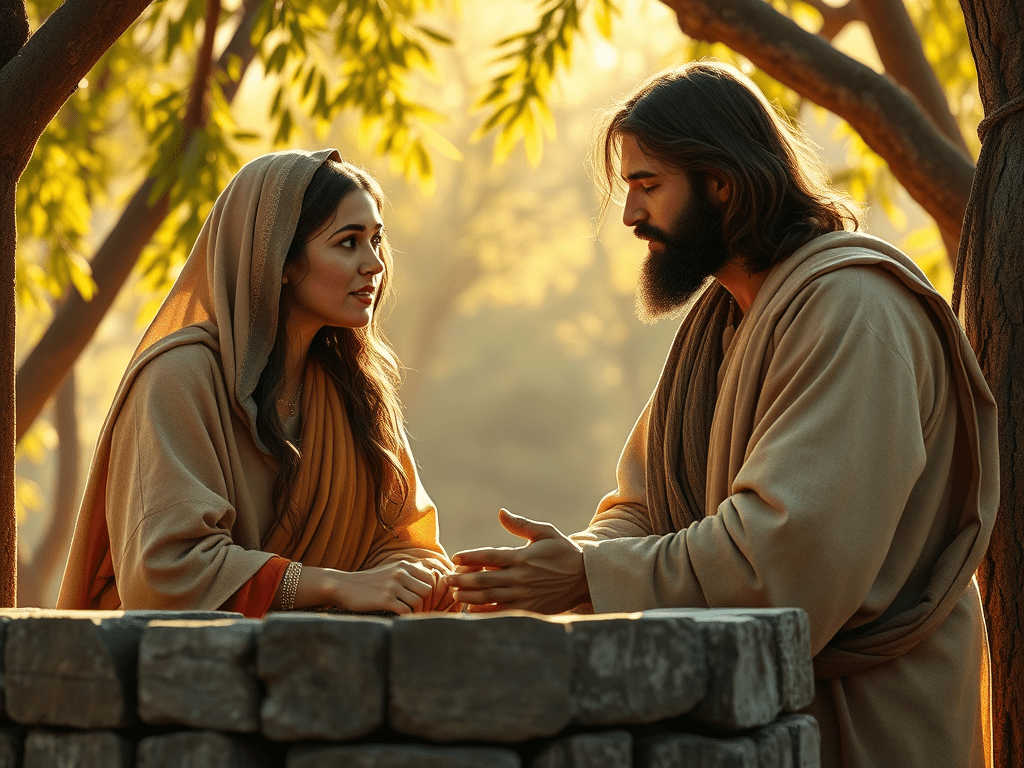
But here, in John chapter 4, we have three groups of people. We have the Samaritan woman at the well. We have the Samaritan townspeople. And we have the Jewish official. And they all hear Jesus’ word and respond, resulting in life. And we see that Jesus’ word sustains and brings life far more than even food or drink. And even Jesus hears his Father’s Word in this chapter, which nourishes him greater than food. We will see that as we get into the chapter.
Now, before we do, I want to mention that due to the length of recent episodes, I am cutting this chapter in half, and I will likely be cutting every chapter in half, at least through the book of John. We’ll see what happens after that.
But I don’t want to sit through an hour and a half podcast when I listen to a podcast. No matter what the topic is, you probably don’t either. So the free show has been right around an hour and a half lately. The Patreon paid program has been closer to two hours. That is entirely too long.
I know the format was originally planned to just go chapter by chapter. It’s getting too long. I got to cut it up.
So we’re going to go through verses 1 through 26 of the book of John chapter 4. We’re going to talk about the Samaritan woman. And then in the next episode, we’ll go through the rest of the chapter. And I will do the gospel thread segment at the end of the next episode for the entire chapter. So we won’t have that at the end of this episode.
So thanks for bearing with me as I experiment and continue to try new things with this podcast. We’re going to try this out, see if it works a little bit better, see if it can keep the episode length a little bit shorter.
By the way, go sign up on Patreon, patreon.com/thegospelthread. You can support the show by subscribing for $4 a month. You get extended episodes, you get early access, you also get to vote on the books that I go through. So voting is currently open for the next book after the book of John.
You can vote on that as a member and would really love your support. That support goes to production costs for the show. The more support I can get, the more often I can kick out these episodes, ideally. So please go support the show if you are able. Always, always very much appreciated.
Let’s get into the chapter.
John chapter four, verse one, it says, Now when Jesus learned that the Pharisees had heard that Jesus was making and baptizing more disciples than John.
So his ministry likely was growing bigger than John’s. And we actually saw that in the previous chapter in verse 26, where it says John’s disciples came to him and said, “Rabbi, he who is with you across the Jordan, to whom you bore witness – look, he is baptizing, and all are going to him.”
So they recognized John’s ministry was shrinking. Jesus’ ministry was growing. Everybody was going to Jesus rather than John. We’re seeing that shift.
And Jesus found out that the Pharisees had heard this, whether or not it was true. The Pharisees found out, or the Pharisees at least heard the rumor that Jesus was making more disciples than John.
So in verse 2, it says, although Jesus himself did not baptize, but only his disciples.
Verse 3, he left Judea, possibly because rumors were flying, possibly because he didn’t want to create division between himself and John. John was a good and trusted friend. And John still had legitimate ministry to prepare the hearts of the people for Jesus. Jesus’ ministry had still recently started. This is not that far from what we can tell into his ministry. So John still had a legitimate ministry.
It’s also possible that Jesus may not have wanted to confront Jewish leadership yet. This is in Judea. This is where Jewish leadership was and where most of the showdowns in this book would be in the region of Judea and in Jerusalem. And if the Pharisees had heard that he was making many disciples, he may not have wanted that confrontation yet.
So he left. Whatever the reason was, he left and departed again for Galilee.
And verse four, and he had to pass through Samaria. Now, Samaria was a region of Israel that had been populated by people of mixed Jewish descent. In the eighth century BC, the northern tribes of Israel were exiled by Assyria. You can read that story in second Kings chapter 17.
They were exiled by Assyria and it says: Because the people of Israel had sinned against the Lord their God, who had brought them up out of the land of Egypt from under the hand of Pharaoh king of Egypt, and had feared other gods and walked in the customs of the nations whom the Lord drove out before the people of Israel, and in the customs that the kings of Israel had practiced.
So they had rejected God. They had sinned against him. They had worshiped other gods and so God drove them out of the land through the nation of Assyria.
And then later in the chapter we read that Assyria settled foreigners in the land and then sent Israelite priests to teach them the law of Moses. We find that in 2 Kings 17, 24-28. And you can read that story on your own. I’m not going read the whole thing for you.
But as a result, the people and the religion became mixed. So you had non-Jewish people, non-Israelite people settling in the land that were not familiar with the Mosaic law. You had the king of Assyria that sent in Israelite priests to teach them the law of Moses. And as a result, the people intermarried and the religion became mixed between the Jewish religion and pagan religions. So they became a mixed people. So there’s a long history between Judah, the kingdom of Judah, and the resettled Jewish tribes and the Samaritans.
So in verse 5, he came to a town of Samaria called Sychar near the field that Jacob had given to his son Joseph. This field probably was the field in Shechem. Genesis 33:18-20 says: Jacob came safely to the city of Shechem, which is in the land of Canaan, on his way from Paddan-aram, and he camped before the city. And from the sons of Hamor, Shechem’s father, he bought for a hundred pieces of money the piece of land on which he had pitched his tent. There he erected an altar and called it El-Elohe-Israel.
That’s the field that this is referring to. And then in Genesis 48:21-22, Israel said to Joseph, “Behold, I’m about to die, but God will be with you and bring you again to the land of your fathers. Moreover, I have given to you rather than to your brothers one mountain slope that I took from the hand of the Amorites with my sword and my bow.”
Not clear from the account in Genesis that this is the same field, but it appears based on the account in the Gospel of John that this is now understood to be the same field. So most likely the town of Sychar at this time is Shechem from the time of Jacob and Joseph.
Verse 6, Jacob’s well was there. So Jesus, wearied as he was from his journey, was sitting beside the well. It was about the sixth hour.
Verse 7, a woman from Samaria came to draw water.
So here we have a woman which provides a contrast to Nicodemus. Nicodemus was the educated Jewish teacher in chapter 3 compared to the uneducated Samaritan peasant in chapter 4.
And that’s where the differences stop because they both do not understand what Jesus is offering, but they both desperately need it. If you remember back to chapter three, Nicodemus did not understand what Jesus was talking about when he said you need to be born again in order to enter the kingdom of God. Here we’re going to see the same thing where the Samaritan woman does not understand what Jesus is going to be talking about in regards to living water.
But we know, as the reader, they both find out that they both desperately need what Jesus is offering them. Very different people, very different backgrounds, but they both need the same thing.
So she came to draw water. Now women typically came to draw water when it was cooler in the day and they came with other women. So the fact that this woman is alone at noon tells us she is trying to avoid something or someone. Or she is not welcome with the other women.
So Jesus says to her, “Give me a drink.”
Just like the servant asked when looking for a bride for Isaac back in Genesis 24. If you listen to the old Beyond the Basics podcast, you remember that that story in Genesis chapter 24 is about a father sending a servant to look for a bride for his son, which points to God sending his prophets to Israel to betroth her to the Messiah.
And if you did not listen to the old Beyond the Basics podcast, you can still find it out there, I believe. But also I’ll be reposting that chapter pretty soon. Should be should be pretty soon. I’ll have that reposted under the the Gospel thread podcast so you can take a listen. But that’s that’s what Chapter 24 is about.
Now, Jesus is standing at the well owned by that very family, this very family, the family of Abraham. Abraham had sent a servant to look for a bride for his son, Isaac. Now Jesus is standing at the well that was owned by Abraham. And here comes a woman. He meets a woman. We’re instantly taken back to that story.
What does that say to us? I think we’re supposed to recognize that Jesus has come to fulfill the promises given to Abraham. When Abraham sent a servant to find a bride for his son so that the promises given to Abraham could continue down his family line, so that his son could have a child, who could then have a child, who could then have a child, and so on and so on and so on, until we get to Jesus who now appears at this well owned by that family, owned by Jacob.
It’s like a homecoming. Even though he’s in Samaritan territory, even though it’s no longer considered part of Israel. It’s a homecoming. He’s coming back to the family’s property. He’s coming back to the area where Abraham’s servant had found a woman for Isaac.
Now Jesus is meeting a woman, a Samaritan woman. She’s neither Jew nor Gentile. She’s mixed. She’s both. So are the promises just for Abraham and his family? No. This shows us that the gospel, the promises given to Abraham, is for neither Jew nor Gentile, but for both. Both Jew and Gentile are invited to enter into the New Covenant.
What does that mean? What is that covenant? What is the promises given to Abraham that result in the Gospel and this New Covenant? Well, God promised Abraham that he would have a son and his family would bless the whole earth. That the whole earth would be blessed. It was pointing toward the one who would be the snake crusher from Genesis chapter three. That’s what it’s really looking forward to.
And so now we see Jesus coming to fulfill that promise given to Abraham. He is going to be the one to come crush the head of the snake. He is going to be the one to come bless the whole earth, not just Jews, not just the family of Abraham, but Gentiles also. Both can come and enter into the covenant that Jesus will institute later on in the book.
We’ll get there. It will take a while, but we’ll get there.
Verse 9, the Samaritan woman said to him, “How is it that you, a Jew, ask for a drink from me, a woman of Samaria?”
She was well aware of the problems between Jews and Samaritans. Her initial response was distrust. She didn’t even understand why Jesus wouldn’t be bothered by this. She didn’t understand why Jesus would even ask her for a drink of water. She knew he was a Jew. She knew she was a Samaritan. She knew that there were all sorts of problems between the two. Not just a man asking for a drink from a woman, but a Jew asking for a drink from a Samaritan.
And it even tells us in parentheses, for Jews have no dealings with Samaritans. So she was already surprised that Jesus would even ask her for anything.
But what’s happening here is Jesus is taking the role of the servant. Again, remember back to Genesis 24. The servant asked Rebecca, the woman, for a drink. Now Jesus is asking the Samaritan woman for a drink. Jesus is taking the role of the servant. He is humbling himself in front of this woman. He is bringing himself low into the form of a servant and elevating the Samaritan woman who was so hated by Jews.
So she asks Jesus a question. “If you’re a Jew, why are you asking for a drink from me, a Samaritan woman?”
Verse 10, Jesus answered her, “If you knew the gift of God, and who it is that is saying to you, ‘Give me a drink,’ you would have asked him and he would have given you living water,” which continues the theme of water as purification and life.
Water has been a constant theme in the book of John. Every single chapter has mentioned water, especially in the context of purification. Both Jesus and John baptized with water. Jesus turned water into wine in chapter two. Jesus told Nicodemus he had to be born of both water and spirit. There’s other references to water throughout those chapters as well. It is a very prominent theme in the book of John, that theme of water as purification, water as life-giving.
Now, Jesus here is offering living water, but God is the only source of living water. So imagine what this woman would be thinking. She may have even known the scriptures. I don’t know how much the Samaritans knew the scriptures. But Jeremiah 2:12-13 says, “Be appalled, O heavens, at this; be shocked, be utterly desolate, declares the Lord, for my people have committed two evils; they have forsaken me, the fountain of living waters, and hewed out cisterns for themselves, broken cisterns that can hold no water.”
So Jesus here is offering something that only God can offer. Imagine what this woman would be thinking, or even his disciples.
And just like Jeremiah accuses the people of hewing out broken cisterns or broken wells that can hold no water, Jesus is saying, “This water that you are drawing from this well is a broken cistern. It’s useless. It’s not going to give you life. It has no living water. I have living water.”
This is a pretty astounding claim. Again, I don’t know how much the woman would have known the scriptures. I don’t know how much the Samaritans had of the scriptures. But if she knew it, if she knew the scriptures, if she did, and certainly anybody who was listening, certainly the disciples would have recognized what Jesus is doing here. He is putting himself in the place of God, which of course he is, but he is placing himself directly in that quote from Jeremiah and saying, “I am the fountain of living waters. You have hewed out broken wells, broken cisterns, and this is evil. So come to me and I will give you living water. I am the source.”
The woman doesn’t understand. Can we really expect her to? Maybe, maybe not. I don’t know.
But in verse 11, the woman said to him, “Sir, you have nothing to draw water with, and the well is deep. Where do you get that living water?”
She had no idea what Jesus was trying to say. Just like Nicodemus didn’t understand the idea of the new birth. Nicodemus obviously, clearly, had the scriptures. I mentioned in the last episode that that idea of new birth was referring back to the prophet Ezekiel. This encounter right here is referring back to the prophet Jeremiah.
So it doesn’t matter whether they have the scriptures or not. Nicodemus didn’t understand, the Samaritan woman doesn’t understand.
It’s not a problem of knowing the Bible. It’s a problem of our broken selves. We have tried for generations upon generations upon generations to fix things ourselves, do things ourselves, to create our own way, to create our own religion, to get to God, to get to heaven on our own merits. We cannot do it. And when someone comes and says, “You’re not going to do it, there’s no way you got to come to me, the source of life,” we just don’t understand because it is something that is broken within ourselves.
Verse 12, she says, “Are you greater than our father Jacob?”
Verse 13, Jesus said to her, “Everyone who drinks of this water will be thirsty again.”
Now, of course, water gives life because without it, we will die. Don’t try to test that. You will die if you try to go without water. It just doesn’t work. Life doesn’t work without water. But we need to keep drinking and drinking. You have to drink water every day. If you don’t, you will die.
Verse 14, “But whoever drinks of the water that I will give him will never be thirsty again.”
Now Jesus isn’t talking about literal water, but he is creating a picture to help her understand. Water is the most basic necessity of life. What Jesus is offering is even more basic than water. He is saying, “I am the source of all life.”
He’s saying, “I am even more necessary for life than water.”
Later, the author of the Gospel of John will clarify that all this water imagery is about the Holy Spirit. In John 7:37-39 it says: On the last day of the feast, the great day, Jesus stood up and cried out, “If anyone thirsts, let him come to me and drink. Whoever believes in me, as the Scripture has said, ‘Out of his heart will flow rivers of living water.’” Now this he said about the Spirit, whom those who believed in him were to receive, for as yet the Spirit had not been given, because Jesus was not yet glorified.
So, if you’re not sure how to get the Living Water, how you can drink of the Living Water and never be thirsty again, it’s because John is referring to the Holy Spirit. The Holy Spirit is who we receive when we become followers of Jesus, when we give our lives to Him, we receive the Holy Spirit. We never have to thirst again because we have the Holy Spirit with us at all times.
This doesn’t mean that we only come to Jesus once and never have to come to him again. I’m not saying we just say the prayer of salvation and never have to talk to Jesus again after that. That’s not the image.
The image is referring to our satisfaction. The well water comes from the earth or from the world and it never satisfies. Living water comes from Jesus, the Holy Spirit, and will satisfy forever. We will never be truly satisfied with well water, with water from the earth. We will always need more. But with Jesus, we will be satisfied forever. We will never need anything more. Everything we have ever desired, everything we have ever needed, will find satisfaction in Jesus Christ. That’s the image here.
He says, “The water that I will give him will become in him a spring of water, welling up to eternal life.”
Verse 15. The woman said to him, “Sir, give me this water.”
So now she’s asking Jesus for water, rather than Jesus asking her for water. So she’s definitely interested in what Jesus is offering, but she still doesn’t fully understand yet. Because she says, “So that I will not be thirsty or have to come here to draw water.”
She’s more interested in saving herself time and energy, possibly embarrassment. She wanted convenience or possibly an escape from shame. That’s what she’s interested in. “Give me this water so I don’t have to come to this well anymore.”
So in verse 16, Jesus said to her, “Go, call your husband, and come here.”
So Jesus changes subjects because she’s clearly not understanding the water metaphor. So he turns the conversation toward her sinful lifestyle. Until now, she just wanted the benefits of an easier life from the living water. But true life cannot come without conviction of sin and repentance. John 3:20-21 says: For everyone who does wicked things hates the light and does not come to the light, lest his works should be exposed. But whoever does what is true comes to the light, so that it may be clearly seen that his works have been carried out in God.
Anyone who comes to the light will have wicked works exposed. True life cannot come without conviction of sin. You cannot come to Jesus and have living water just for convenience or an easier life.
There is so much of the gospel going around right now that just talks about the love of God, how much God loves you, without any call to action to repentance. And I fear that a lot of people that have received that partial gospel, partial good news that God loves you – and that’s true, God does love you – are not actually saved even though they’re told they’re saved. They think they’re saved because there’s no actual conviction of sin. And there’s no actual repentance because they’re not told it’s necessary.
You cannot receive living water without conviction of sin and repentance. And we cannot preach a gospel that doesn’t include all of those things.
17, the woman answered him, “I have no husband.” Jesus said to her, “You are right in saying ‘I have no husband’; for you have had five husbands, and the one you now have is not your husband. What you have said is true.”
Jesus knew what was truly in her heart. We saw that earlier in John chapter two verses 23 through 25 says: When he was in Jerusalem at the Passover Feast, many believed in his name when they saw the signs that he was doing. But Jesus on his part did not entrust himself to them, because he knew all people and needed no one to bear witness about man, for he himself knew what was in man.
He knows what’s in our hearts. He knew what was in this woman’s heart. He asked for her husband, knowing that she had none, knowing that just because she lived with a man didn’t mean that she was actually married to that man. Which may have contributed to the shame that she felt and why she was going to the well at this time of day.
But Jesus knew what was in her heart. He knows what’s in all of our hearts. We can’t hide anything from him. Why should we try? She tried to hide the fact that she was living with a man that was not her husband by saying, have no husband. What she said is true, but is not the full truth. Jesus knew what was truly there and he called it out. Much better for us to just confess and repent.
But this had an effect. Verse 19, the woman said to him, “Sir, I perceive that you are a prophet.”
So he had just told her intimate details of her life that he shouldn’t have known. Now she is finally understanding that this is a man sent by God. That’s what it took.
Which is interesting because the Samaritans didn’t recognize any of the prophets after Moses as legitimate. Moses in Deuteronomy 18 spoke of a greater prophet who would come after him. Moses said in verse 15, “The Lord your God will raise up for you a prophet like me from among you, from your brothers – it is to him you shall listen – just as you desired of the Lord your God at Horeb on the day of the assembly, when you said, ‘Let me not hear again the voice of the Lord my God or see this great fire anymore, lest I die.’”
So Moses talked about a prophet that was to come that would be greater than him. The Samaritans believed that Deuteronomy’s closing statement was still in effect in Deuteronomy 34:10-12. It says: And there has not arisen a prophet since in Israel like Moses, whom the Lord knew face to face, none like him for all the signs and the wonders that the Lord sent him to do in the land of Egypt, to Pharaoh and to all his servants and to all his land, for all the mighty power and all the great deeds of terror that Moses did in the sight of all Israel.
So what that’s saying in Deuteronomy 34, somebody came after and wrote in there that ever since Moses, there hasn’t been a prophet like him. The Samaritans took that to mean that there were no prophets at all since Moses. Not just lesser prophets, but no prophets. So none of the prophets that came to Israel after Moses were seen as legitimate. Not Isaiah, not Jeremiah, not Ezekiel, not any of them. None of them that came they saw as legitimate because they saw Moses as the prophet who spoke of the greater prophet to come and since that greater prophet hadn’t come yet, no prophets had come.
That’s how they saw it. So it was quite the claim for her to recognize him as a prophet. This is not something that a Samaritan would just do lightly.
So in verse 20 she says, “Our fathers worshiped on this mountain.”
So she’s trying to change subjects to avoid discussing her sin. She recognized, “Oh, you called out my sin. You’re a prophet. You must be sent from God. Why don’t you answer this theological question for me?”
She says, “Our fathers worshiped on this mountain, but you say that in Jerusalem is the place where people ought to worship.”
Totally changes the subject. Totally sidesteps her sin. She’s saying, “Hey, you’re a man of God. I’ve been wondering about this theological question. Can you give me an answer here?”
So according to the law, God could not be worshiped just anywhere. He had to be worshiped in Jerusalem, in the temple. Deuteronomy 12:5-7 says: But you shall seek the place that the Lord your God will choose out of all your tribes to put his name and make his habitation there. There you shall go, and there you shall bring your burnt offerings and your sacrifices, your tithes and the contribution that you present, your vow offerings, your freewill offerings, and the firstborn of your herd and of your flock. And there you shall eat before the Lord your God, and you shall rejoice, you and your households, in all that you undertake, in which the Lord your God has blessed you.
So the command was: Find the place that the Lord your God will choose, there worship Him, and there only.
And that’s what she’s saying: “You say that in Jerusalem is the place where people ought to worship.”
She’s saying, “You Jews believe that that place that God chose in Deuteronomy chapter 12 is in Jerusalem.” But she says, “Our fathers worshiped on this mountain.”
So her question is, “Which is it? If you’re sent by God, what’s the answer here? Do we worship here or do we worship in Jerusalem?”
Verse 21, Jesus said to her, “Woman, believe me, the hour is coming when neither on this mountain nor in Jerusalem will you worship the Father.”
It was never God’s intention to be worshipped only in Jerusalem. Zephaniah 2:11 says: The Lord will be awesome against them; for he will famish all the gods of the earth, and to him shall bow down, each in its place, all the lands of the nations.
So the nations will bow down and worship God in their own land, in their own places. They will not all come to Jerusalem. They do not need to. They can all worship from their own lands.
Malachi 1:11 says: For from the rising of the sun to its setting my name will be great among the nations, and in every place incense will be offered to my name, and a pure offering. For my name will be great among the nations, says the Lord of hosts.
God’s intention is for worship to take place in Jerusalem so that the nations would see and worship him from their places so that in every place in every nation worship would go up to the God of Israel. That’s God’s intention.
He says, “Nor in Jerusalem will you worship the Father.”
Verse 22. “You worship what you do not know; for salvation is from the Jews,” and that’s true.
But he says in verse 23, “But the hour is coming, and is now here, when the true worshipers will worship the Father in spirit and truth.”
Now first century eschatology would have expected the Messiah’s kingdom to come all at once. They expected Jesus to come, not Jesus specifically, but the Jews would have expected the Messiah to come, conquer their enemies, set up his kingdom, reinstitute the throne of David over the nation of Israel. That’s what they would have expected.
But Jesus is saying that there’s both a present and a future reality. Saying the hour is coming and is now here. How is that possible? That statement doesn’t really make a whole lot of sense. But what he’s saying is that we can experience some of the realities of the age to come right now. There is the age to come where first century eschatology will be institutionalized. It will happen. Jesus will come, he will conquer Israel’s enemies, he will set up his throne in Jerusalem and reestablish the throne of David over the nation and rule over the planet. That will happen, but not at his first coming.
So he’s defying expectations, but he’s saying we can still experience some of that reality right now, including in the way that we worship, but those realities won’t be fully realized until the age to come.
So he says, “When the true worshipers will worship the Father in spirit and truth.”
So it’s not about where we worship, but how we worship. How do we worship? We must worship wholeheartedly, understanding our spiritual need for Jesus and rooted in the revelation of the truth of Jesus Christ in all the scriptures. In spirit and truth.
We worship with our whole lives. Worship isn’t just singing some really great emotionally stimulating songs on Sunday morning. Worship is a lifestyle of living devoted and submitted to the leadership of Jesus Christ. Every single day, in every aspect of our lives, that’s the spirit part.
And the truth part is understanding that Jesus Christ, the Messiah, has been revealed in the scriptures from Genesis to Revelation, seeking him out day by day, meditating on the truths that have been communicated by God through these human authors that we now read in our Bibles. That’s true worship.
And he goes on to say, “For the Father is seeking such people to worship him.”
Unlike other religions where people seek out a distant god, God actively seeks out people who will worship him properly. Luke 15:3-7 says: So he told them this parable, “What man of you, having a hundred sheep, if he has lost one of them, does not leave the ninety-nine in the open country, and go after the one that is lost, until he finds it? And when he has found it, he lays it on his shoulders, rejoicing. And when he comes home, he calls together his friends and his neighbors, saying to them, ‘Rejoice with me, for I have found my sheep that was lost.’ Just so, I tell you, there will be more joy in heaven for one sinner who repents than over 99 righteous persons who need no repentance.”
God seeks out the lost. God seeks out the one who will worship. God seeks those he loves. God seeks those that he calls.
That’s the difference between the God of Israel, the God of the Bible, and any other God in any other religion. Every other religion, we, the people, the individual, has to strive for God. The God of the Bible seeks us out and calls us.
Verse 24, “God is spirit, and those who worship him must worship in spirit and truth.”
Because God is spirit we must worship him with spiritual worship. Not just outward, but inward. Not just performative, but with humility, gratitude, pure repentance when we sin. This is spiritual worship. This is true worship.
Verse 25: The woman said to him, “I know that Messiah is coming (he who is called Christ). When he comes, he will tell us all things.”
Essentially what she’s saying is, “The Messiah will clarify all these questions for us. I know that when the Messiah comes, He’s gonna clarify this stuff for us.”
She may have been testing Him to see if He was truly the Prophet, truly the Messiah.
So Jesus said in verse 26, “I who speak to you am He.”
Jesus is actually claiming to be the Messiah here. Jesus has the authority to define worship because He is the Messiah. So he is clarifying what she’s asking. He’s saying, “Yes, the Christ will clarify. He will tell you all these things. And I’m the Christ, so I’m telling you these things.”
This is the first time in the book that Jesus claims to be the Messiah. He would have caused a political uproar in Judea by saying this, because they would have expected him to be king. They already had a king. It would have caused a total mess. A lot of people probably would have died. So Jesus did not ever claim to be the Messiah when he was in Judea.
But that problem didn’t exist in Samaria. So he had no problem with claiming to be the Messiah in Samaria.
So, we’re gonna end there for this week. We’ll continue the chapter in the next episode.
But, before I do, I want to remind you, please, whatever platform you’re listening on, click like, click subscribe, help spread the word of the show, not for my benefit, but so that hopefully more people can be blessed by the word, by hearing the gospel by another resource of many that hopefully will help disciple people. That’s my goal, to help disciple people and bring people into the saving knowledge of Jesus Christ.
So if you can do that, click like, click subscribe to help those algorithms notice the show a little bit more as well as supporting the show on patreon.com/thegospelthread. It is always very, very much appreciated.
So before I let you go, let’s ask a question for reflection until the next episode. And that question is, what did you learn from this chapter that will help you better worship in spirit and in truth? As you were reading, as you were listening, what stuck out to you that will help you better worship in a more wholehearted way, or something that maybe opened up the scriptures to you?
Meditate on that question and let’s pray.
Lord, thank you so much for your word. Thank you that we can still read them thousands of years later and we can still meditate on them. We can still learn. I pray that those who hear that your word would penetrate their hearts. Would your word penetrate all our hearts so that as we worship, as we live our lives, we would live a life fully dedicated to honoring you, to glorifying you.
And Lord, help us to recognize the areas in our lives where we have dug broken cisterns, broken wells. Help us to come to you for living water. Holy Spirit, would you continue to give us life for those of us who have received you and for those of us for those who are listening who have not received you would you convict of sin and draw them to you so that they would receive living water as well. In Jesus name, amen.
Thank you once again for listening. I look forward to finishing this chapter with you in the next episode. Like I said, I’m going to continue splitting up these chapters, make these episodes a little bit shorter. I’m already looking at the raw audio as I’m recording, and it’s significantly shorter than previous episodes. So I think I met my goal of making these episodes a little bit shorter.
So I’ll talk to you next time. We’ll finish chapter four of the Book of John. Thanks for listening.
Sources:
Bruce, F. F. (1983). The Gospel of John: A Verse-By-Verse Exposition. Kingsley Books.
Mounce, R. H. (2007). The Expositor’s Bible Commentary: John. Zondervan.
Guzik, D. (2024c). John 4 – A Samaritan Woman and a Nobleman Meet Jesus. Enduring Word. https://enduringword.com/bible-commentary/john-4/
Music:
Ain’t No Mercy Here – Def Lev
Dominoes (Instrumental Version) – APE
Them Fibers In My Holy Body (Instrumental Version) – Bjurman
Bonafide (Instrumental Version) – Bankston
TIME OUT (Instrumental Version) – Andrea Turk
Enough This Time – Rockin’ For Decades
 Beyond The Basics
Leave a comment