
Transcript:
Welcome to the Gospel Thread Podcast. My name is Dan Snyder and I’ll be your host as we study the Bible to discover the story of the Gospel spread throughout the Scriptures from Genesis to Revelation.
On February 15th, 1898, an explosion destroyed the USS Maine as it harbored in Havana. Journalists William Randolph Hearst and Joseph Pulitzer blamed it on the Spanish even though no cause has ever been established. It was never proven that Spain caused the explosion.
However, due to their journalism, this set the pretext for war with Spain, which was declared on April 24th, and the phrase “Remember the Maine” became famous during this war.
Now the war only lasted a few months and it resulted in the U.S. winning control of Puerto Rico, Guam, the Philippines, and they were recognized as a world power. They had defeated one of the largest European empires in the world. Cuba gained its independence in this war.
Now, this is an example of how belief in someone’s word can affect actions. The country’s belief in these journalists, William Randolph Hearst and Joseph Pulitzer, caused the country to go to war with Spain. And the result of this war is, are things that we see today. And the results are ongoing. Even today, we see calls for Puerto Rico to be the 51st state in the Union. So even today, this affects us. This was 125 years ago or more.
Belief in somebody’s word can affect actions and it can affect history. We’re gonna see that in the second half of John 4, how belief in Jesus’ words can affect people’s actions.
Now we talked about the three groups of people in this chapter. Really, two individuals and one group of people, but to make it easier, I’ll just say it as three groups of people. The first, of course, was the Samaritan woman, which we spoke about in the last episode. The second is going to be the Samaritans from the town of Sychar. And the third is going to be the official at Capernaum.
Now before we get into the chapter, I want to thank all of the Patreon supporters. All of you have supported the show through clicking like and subscribe. Really, really appreciate all your support.
I know I was hoping by this point to be able to be pumping out episodes a lot faster than I currently am. Turns out that working a full-time job and having three children under the age of five at home leaves very little time for working on an in-depth Bible study podcast. So I have come to terms with the fact that these episodes are not going to be released very often unfortunately. I’m going to try and get them out as quickly as possible. But it looks like it’s going to be at most every couple months or so for the time being. Obviously, I’ll try to get them out sooner than that if I can.
But for those of you who have been supporting me on Patreon, thank you. If you are enjoying the free show and you would like to hear more, you can join Patreon and support the show for four dollars a month, patreon.com/thegospelthread and you’ll get an extended version of this podcast. It’s usually 20 minutes or so extra content, depending on the episode. I leave everything in. There’s a lot of stuff I cut out for the free show to try and keep it focused on the, the main theme of the chapter. I leave all that extra stuff in on the Patreon show.
You also have the ability to vote on the next book that I go through after the book of John. You can vote on the next one. You get early access to these shows. I post them as soon as they’re done editing. So you get a good amount, though I’m not posting very often. So if you’re a free subscriber on Patreon, or if you’ve only heard the free show on your podcast app and you would like to sign up for $4 a month, I really appreciate it.
That money just goes to support the show. It helps pay for editing, helps pay for music licensing, helps pay for the website, things like that. So thank you for all your support.
And if you would like to continue to support the free show, remember just click like, click subscribe on whatever you’re listening to. It will be a very, very big help. Thank you all.
All right, let’s get into the chapter. We are starting in John chapter four, verse 27. We did the first 26 verses in the previous episode. We talked about the Samaritan woman and now we’re picking up in verse 27. And it says: Then his disciples came back. They marveled that he was talking with a woman – because it was considered to be a waste of time to have a prolonged conversation with a woman. Even one who was Jewish, much less Samaritan. Obviously we talked last episode about the societal implications of a Jewish man talking to a Samaritan woman.
But no one said, “What do you seek?” or, “Why are you talking with her?”
So they didn’t question Jesus. The disciples knew that he had reasons for doing what he was doing. They knew he had reasons for talking with this woman. They weren’t around for the conversation. But they didn’t ask him. They trusted him.
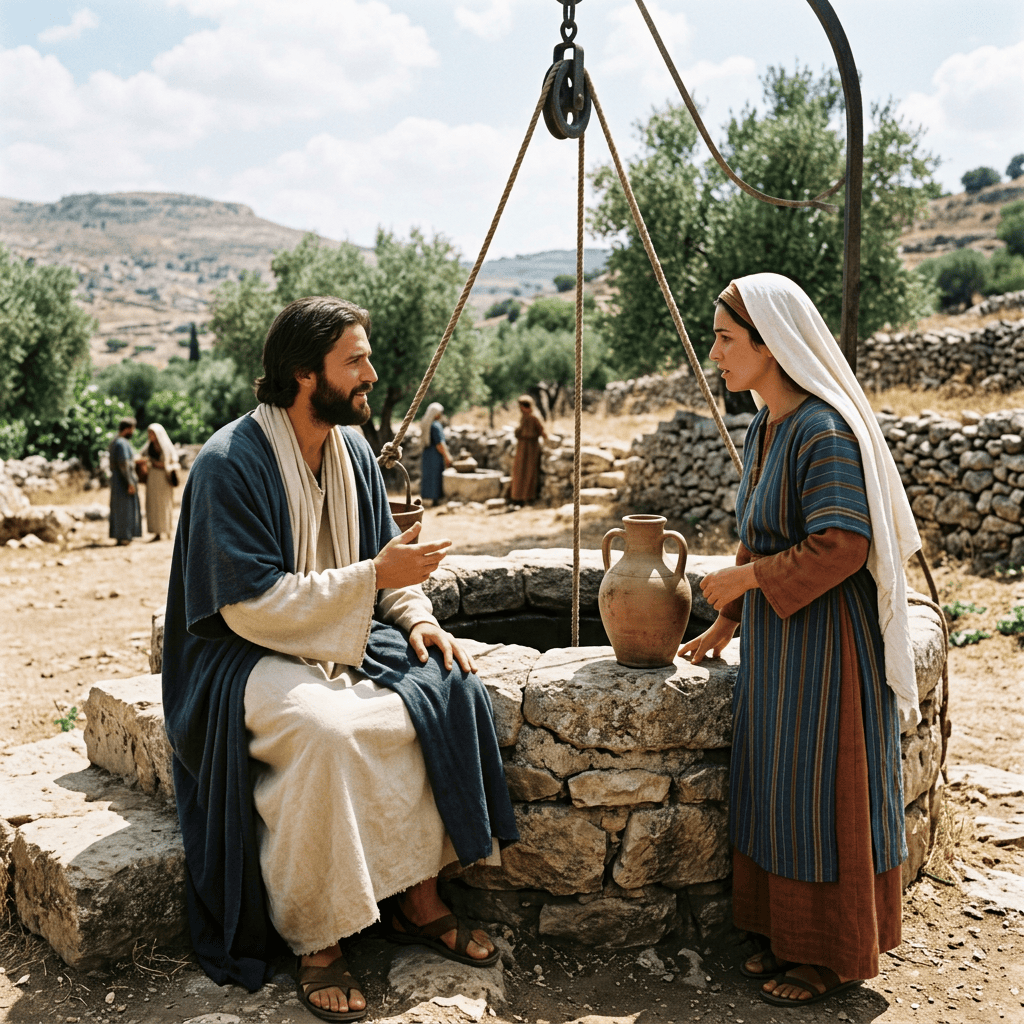
So in verse 28, the woman left her water jar and went away into town.
She left her water jar. Isn’t that interesting? She had come to draw water. She had come when nobody else would be there, so nobody would see her drawing water. And now she just leaves her water jar there.
Why did she leave her water jar there? It’s because she had the living water. She spent this whole time talking to Jesus about this living water that he had to offer. And she was just not getting it, not getting it, not getting it. She thought he had actual water, like liquid water, until the end. And now she leaves her water jar there. Because now she has the living water. She received the living water that Jesus was offering. So what does she need a water jar for?
Eventually she’ll come back and get it, I’m sure, but it’s a literary device to tell the reader: this woman has received the water that Jesus was offering, so she no longer needs the water that she was seeking.
So she went away into town and said to the people in verse 29, “Come, see a man who told me all that I ever did.”
Verse 30: They went out of the town and were coming to him.
So the people started coming to see him at this woman’s word. The woman heard Jesus’ word, leaves her water jar there at the well and goes and tells the townspeople to come and see. They believe her word and come to see Jesus.
Verse 31: Meanwhile the disciples were urging him, saying, “Rabbi, eat.” But he said to them, “I have food to eat that you do not know about.”
So he’s not talking about physical food, just like he was not talking about physical water when he was discussing the living water with the woman. He’s talking about spiritual water.
Verse 33: So the disciples said to one another, “Has anyone brought him something to eat?”
So Jesus here says he had food, but they didn’t see anybody bring him any food. They didn’t understand he was talking about something else, just like the woman at the well. The woman thought that Jesus had different physical water to offer than the water that was at that well. Maybe he had another well somewhere that he had dug that had this living water. That’s what she thought he was talking about. Just like the disciples here think that Jesus is talking about food that he has that maybe somebody else brought to him, but they didn’t see anybody bringing him any food so they didn’t understand what he was talking about.
So in verse 34 Jesus said to them, “My food is to do the will of Him who sent me and to accomplish His work.”
Jesus is nourished by obedience to the Father.
Deuteronomy 8:3 says: He humbled you and let you hunger and fed you with manna, which you did not know, nor did your fathers know, that he might make you know that man does not live by bread alone, but man lives by every word that comes from the mouth of the Lord.
See, Jesus understood these words fully. Jesus understood that his body, his very being was nourished by obedience to the Father, by hearing God’s Word and living by that Word.
We do not fully comprehend this like Jesus did. We can’t comprehend how our bodies could survive without physical food. And I’m not saying that your body can just survive forever without physical food. That’s not at all what I’m saying. Please eat food. You need food.
What Jesus is revealing a spiritual concept here, it’s not about our physical bodies. Nourishment to our physical bodies is not what’s important. It’s nourishment to our very soul. It’s nourishment to our very being. That is what truly gives us life.
And what is that nourishment? It’s the word of the Lord. It’s hearing God’s word and obedience to God’s word. It’s hearing, reading His word in the scriptures. It’s obeying what He says, doing what He says, accomplishing His work.
Jesus said his food is to do the will of him who sent me and to accomplish his work. That’s what his food is. How does he know what God’s will is without hearing his word? So he hears his word and then he does his will.
Deuteronomy tells us this is not applicable only to Jesus. It’s applicable to us, to every single one of us. We do not live by bread alone. We do live by bread. We do need food. But true life comes from every word that comes from the mouth of the Lord. True life comes from hearing the will of God and doing the will of God.
And the good news here in this verse is that Jesus has plenty of food because there’s a great harvest out there. There’s a great harvest of people who do not know him and that are about to come to him. That entire town of Sychar.
There’s a great harvest out there for us as well. There’s so many people that don’t know, that have never heard the gospel, that have never heard the good news of Jesus Christ, that have never witnessed the power of the cross, that have never heard that Jesus took our sin, died our death, and broke the power of death and rose again to eternal life so that we can have eternal life. There’s so many people out there that have never heard that.
We have plenty of food to eat because there’s plenty of harvest. And Jesus is going to talk about that harvest.
In verse 35, he says, “Do you not say there are yet four months, then comes the harvest? Look, I tell you, lift up your eyes, and see that the fields are white for harvest.”
So the harvest is ready. There’s no need to wait any longer for the harvest. That’s what Jesus is saying here. He’s saying, “You might be waiting another four months for the harvest in your fields back at home, but here you don’t need to wait. Lift up your eyes, there’s harvest everywhere. The fields are ready.”
And this is still true. The harvest is even greater now because there are billions more people on the earth than there were then. The fields are white for harvest.
In fact, it’s May 31st as we record this, which is interesting because for certain crops, we’re about four months away from harvest if you’ve got fall crops like squash and pumpkin. In my yard, I’ve got persimmon trees. I won’t have persimmons until at least September 31st, about four months away from the harvest for certain crops.
And yet the fields are white for harvest. The harvest is ready. We don’t need to wait.
Verse 36 says, “Already the one who reaps is receiving wages and gathering fruit for eternal life, so that the sower and reaper may rejoice together,” because they both took part in the harvest. And each one has their roles. Both the sower has their role and the reaper has their role. One sows and one reaps.
We shouldn’t get discouraged at only being a sower. Many of you listening – I know because I’ve felt this in my own life – have gotten discouraged at sharing the gospel and never seeing anybody come to the saving knowledge of Jesus Christ. And you have preached the gospel faithfully throughout your Christian life and have never seen anybody get saved. Don’t get discouraged at being only a sower. You are not only a sower, you are someone who faithfully followed the command of Jesus to preach the gospel.
And both the sower and the reaper will rejoice together in the end. The prophets sowed for generations and would often get discouraged. They sowed and sowed and sowed into a nation who refused to listen, but they will rejoice in the end along with those who reap the harvest, along with the disciples. They will rejoice along with the disciples who reap the harvest in the same way.
Preach the gospel. Don’t get discouraged. You will rejoice along with those who get to reap the harvest.
Verse 37, “For here the saying holds true, ‘One sows and another reaps.’ I sent you to reap that for which you did not labor.”
Alright, so moving on into verse 39. It says the people believed the woman’s testimony about what Jesus said. They didn’t need a sign, which is interesting because it sounds like this woman was not very well thought of in this town but they believed her. She must have had a pretty compelling testimony. The work of God in her life must have been pretty compelling. Maybe that’s a better way to say it. They didn’t need a sign. They heard the word and they acted.
So when the Samaritans came to him, they asked him to stay with them and he stayed there two days and many more believed because of his word. So first they believed the woman. Now they believe Jesus himself.
This is how evangelism should work. Our testimony should invite others to come see Jesus himself. Our testimony should never invite people to see us. It should never point people to us. If you see somebody who is preaching the gospel and that gospel is pointing to that person, that person is doing it wrong. Just plain and simple.
And sometimes it’s subtle. We can’t always tell. Sometimes that person will say all the right things. That person will say, “Give glory to God.” All the right things.
How does that person conduct himself? How does that person think of himself.
We have to listen with open eyes. Testimony should always invite people to come see Jesus. We must keep that in mind as we’re preaching the gospel. Never let people come to see us. Always invite people to come see Jesus.
Just like John the Baptist understood his ministry was not about him, but it was about Jesus. Remember in John 3:27-30, John answered, “A person cannot receive even one thing unless it is given him from heaven. You yourselves bear me witness, that I said, ‘I am not the Christ, but I have been sent before him.’ The one who has the bride is the bridegroom. The friend of the bridegroom, who stands and hears him, rejoices greatly at the bridegroom’s voice. Therefore, this joy of mine is now complete. He must increase, but I must decrease.”
John understood he was not there to receive all the attention from the nation of Israel. He received some attention for a while, but he would always deflect it back to Christ. And he reminded people. He’s like, “Guys, I told you, I’m not the Christ. I have only been sent to prepare the way for him. And once his time has come, I am no longer needed. It’s not about me, it’s about him. He must increase, I must decrease.”
That was John’s mindset. That must be our mindset as well in ministry. We must always remember: he must increase, I must decrease. He must increase, I must decrease. That’s so hard. So many of us, because we’re human beings, because we’re normal human beings, are filled with pride and want ourselves to increase.
Even as I do this podcast, I always have to remind myself: he must increase, I must decrease. It is not about me building a podcast. It is not about me building a brand. It is about me pointing people to Christ. That is my whole goal, my whole purpose.
Everything I do in this podcast – it’s called the Gospel Thread for a reason. The podcast, everything I talk about, everything I teach is intended to point people to Christ. I don’t want people to see me. I want people to see Christ. And I want people to respond in a way that increases righteousness, that increases humility, that increases the fruit of the Holy Spirit, the fruit of the gospel in their lives. That’s my purpose.
But it’s tempting, as I promote the show, as I talk about it, it’s tempting to try to build my own brand and build a name for myself. But that’s not why I do this.
We have to have that mindset that John the Baptist had. He must increase, I must decrease.
So many more believed because of his word. Then in verse 42, they said to the woman, “It is no longer because of what you said that we believe, for we have heard for ourselves, and we know that this is indeed the Savior of the world.”
The Samaritans were ready to take Jesus at his word, in contrast from what we have seen from the Jews previously, which is so interesting because Jesus, a Jew, was sent to the Jews, The Samaritans didn’t even have a majority of the scriptures. They had an incomplete understanding of who the Messiah would be. At best, their understanding was incomplete. They did not have the prophets to tell them about what to expect and what he would look like and all that stuff. And yet the Samaritans, as soon as they heard his word, they believe. They know this is the Christ.
How much more humility do we need as Christians who have the full canon of scripture, Old Testament and New Testament? And we can sit here and claim that we know God because we have the scriptures. But do we really? And do we hear who he is as he reveals himself in the scriptures, or do we know who we believe him to be based on our own flawed thinking about the scriptures?
There’s so many things that, as I’ve come out of the Charismatic world over the last few years, that I was taught my whole life about who God is and what he does. And as I’ve come out of that world, I’ve seen, as I’ve read scripture, as I’ve read through and really gone as deep as I can in the study of the scriptures and who God reveals himself to be, that there’s so many things that I was taught and just took for granted that all Christians believe this, only to find out that’s not who God is at all.
For example, one that I recently remember, I was always taught that if you give, you will receive. And this is something that you’ll see a lot in prosperity churches. so they’ll, you know, up front the prosperity preacher will ask for money and say, “If you give, give to the ministry now, give to the ministry now, the more you give, the more you’re going to receive.”
And it’s always a financial gift that you’re supposed to give and a financial gift that they claim that you will receive in return.
But God doesn’t work that way. That’s not a concept in the Bible, anywhere. I can’t find it. I can find that God allows the sun to rise on the just and the unjust. That he sends rain to the just and the unjust. I see that God has compassion on the poor. I see that God clothes us much more than he clothes the lilies of the field. I see that God is sovereign and he chooses who to give, from whom to take away. I see that our giving is done as an act of worship to God. Our giving is done as an act of love for one another, and it has nothing to do with whether or not God provides for us in return. It is a completely unrelated thing.
So that’s an example of something that I believed that wasn’t backed up by scripture. And how many of those things as Christians, how many wrong ideas do we have about God because of what we’ve been taught? And we never bothered to look in the scriptures to find out if it was true.
And it’s funny, you know, with the example that I use, I heard so many people, you know, non-Christians over the years, “Well, how could you worship a God who demands that you give all your money to him? How could you worship, you know – the church has to be a fraud because all they’re doing is constantly asking for money.”
They see through this and it’s exactly the same thing that we see here in this chapter. The Samaritans see through all the twisting of the scriptures that the Jews had done and they see the simplicity of the gospel that Jesus is presenting them with. Living water. Come to me and I will give you living water. It’s so simple. Just come to me. That’s all you need to do. The Jews didn’t get it. The Samaritans did.
We as Christians must make sure that we don’t make the same mistake as the Jews did.
So in verse 43: After two days he departed for Galilee. (For Jesus himself had testified that a prophet has no honor in his own hometown.)
Verse 45: So when he came to Galilee, the Galileans welcomed him, having seen all that he had done in Jerusalem at the feast.
So they saw the cleansing of the temple. They saw all that he had done and they welcomed him for they too had gone to the feast.
Now we pivot to another story that seems unrelated, but we’re going to notice a similar response in this Jewish official in this next story. And that’s why I believe it’s part of this chapter, and that’s why it’s a very important part of this trilogy, in a sense, in this chapter of groups of people that respond to Jesus’ word.
Verse 46. So he came again to Cana in Galilee, where he had made the water wine. And at Capernaum there was an official whose son was ill.
So this is probably a Jewish official of Herod Antipas. So let’s get into this story in verse 47. The official had an ill son in verse 47, when this man heard that Jesus had come from Judah to Galilee, he went to him and asked him to come down and heal his son, for he was at the point of death.
So, there’s no recorded healings by Jesus up to this point in this book. So, it’s unclear how he knew that Jesus would heal his son. The other gospels, of course, record all kinds of healings. But when you read through the other gospels, it appears that Jesus’ ministry was only about a year long. It’s from the book of John that we get the idea that Jesus’ ministry was for three years long because of the number of the Passovers that are mentioned. So it’s possible that many of the miracles and healings that Jesus did in the other gospels have not been done yet.
So how did this man know? Had he heard somebody’s words, somebody’s testimony? Seems fairly likely to me.
So in verse 48, so Jesus said to him, “Unless you see signs and wonders, you will not believe.”
Now this word you is plural referring to the Galileans. They believed because of the signs. Remember in verse 45, the Galileans welcomed him having seen all that he had done, not welcoming him because of what he had said, but they welcomed him because of what he had done. So they believed because of the signs, not because of Jesus’ word.
What do we notice about people who believe in signs rather than in Jesus’ word? Usually that belief does not last long. It’s not a deep belief. But this official here is different as we’re going to see.
Before we get into that, let’s talk about signs and wonders for a minute because there’s a reason why the Gospel of John presents people who believe in Jesus’ Word and people who believe in signs in a very different light.
Signs and wonders validate the message of the gospel. The gospel is preached, the signs validate it. It’s like, it’s a stamp of approval. It’s God’s stamp of approval on this message. But they are not the primary focus of the gospel. The primary focus of the gospel is not the signs and wonders. It is not the healings. It’s not the physical healings. It’s not the miracles. That’s not the primary focus of the gospel.
The focus of the Gospel is the cross, the healing of the heart, the healing of the sickness that has infected all of us, the payment for sin, the receiving of eternal life. That’s the focus of the Gospel, and many ministries today make signs and wonders the focus. And these ministries are the guilty of the same thing as the Galileans.
You see ministries like Bethel. It’s all they talk about is signs and wonders. That’s all they talk about if you’re familiar with Bethel out in California. Again, me coming from a Charismatic background, Bethel was everywhere. And they’ve only grown in influence in the Charismatic world. That’s all they talk about. That’s all they preach on. They say the Gospel is incomplete without signs and wonders.
But that’s not true. It’s not what the Bible says. In fact, you read through the book of John and it’s pretty clear that if you don’t believe the Word, it doesn’t matter how many signs and wonders you see, you have to believe the Word of God. If you only believe because of signs, that belief has no depth and it is not the primary reason why the gospel is preached. And if you preach a gospel that you believe is incomplete without signs, that’s not the gospel. The signs validate the gospel. The signs are not the focus of the gospel.
So do I believe in healings and miracles? Of course I do. Is it something I ever take into consideration when I’m preaching the Gospel? No. That’s not the point. It’s not the purpose. The purpose is the payment for sin so that we can call people to repentance and surrender to the leadership of Jesus Christ and receive eternal life.
Ministries like Bethel are guilty of the same thing as the Galileans. They believe the signs. They see the signs that Jesus did and they get excited about all the cool things and as a result they leave behind the actual gospel. They leave behind the Word.
And I remember seeing this all the time because I would see, because I would do a lot of the things that Bethel taught. When you’re supposed to be preaching the gospel, they would tell you, do treasure hunting. I don’t know if you’ve ever heard of that. You do treasure hunting and you, you know, pray and try to find some sort of description or something that would apply to somebody and then you go find somebody that matches that description, then you give them a prophetic word and then you pray for them and then you leave. And when was the gospel ever preached?
I did that so many times. I don’t know if I actually preached the gospel to somebody or if I just prayed for them to have a better life.
Uh, oops.
You know, that’s not what Jesus commanded us to do. He commanded us to preach the gospel and make disciples. It doesn’t matter how many people I prophesied to. It doesn’t matter how many people I prayed for for healing and saw them healed, if their hearts were never healed, if they never turned from their sin.
So, we don’t want to be guilty of what the Galileans were guilty for.
And thankfully here, the official understands. He hears the word somehow that Jesus can heal and he believes.
So he says in verse 49, “Sir, come down before my child dies.”
So the official was in a hurry. Obviously, this child was very close to death. Jesus said to him, “Go, your son will live.”
So instead of going to perform the sign, Jesus gave the official his word. So the author here is showing us again the importance of Jesus’ word. Jesus said, “Hey, you guys don’t believe unless you see the signs and wonders. Unless you see these healings, unless you see these wonders, you guys don’t believe.”
He’s talking to the Jews.
So the official says, “Please, come heal my son before it’s too late.”
So Jesus says, “I’m going to do it, but I’m not going to allow you to see it. I want you to believe my word.”
So he says, “Go, your son will live.”
Imagine how hard this would be for a father to do. He had to take Jesus at his word. He had to just turn around and go home, having faith that what Jesus said He would do. This would be so incredibly hard for a father. A father is not gonna stop at anything to save their child. And what Jesus is asking this man to do is to turn around. Go home. “If you believe me, then your child is healed.”
Not that the healing depended on the man’s faith. What I’m saying is, Jesus is telling this man, “I’ve healed your child. You can believe me and you can go home. Or you can not believe me and you can continue to try to find a solution.”
Jesus was seeing, He’s testing His faith, He’s seeing where His faith is at.
But in verse 50, the man believed the word that Jesus spoke to him and went on his way.
So Jesus had not done this type of miracle yet, but the official believed Jesus’ word before the miracle had taken place. Again, to reiterate, Jesus said to the people, “You guys never believe without a sign.”
This man says, “I’m different. I believe. But I’m asking for a sign.”
Jesus says, “Okay, you want a sign? You say you believe? I’m not going to allow you to see the sign. You have to just believe that I did it because of my word.”
And the official, what does he do? He turns around, he goes home because he believes Jesus’ word. This man put his money where his mouth is.
So in verse 51: As he was going down, his servants met him and told him that his son was recovering.
So he didn’t have to make it all the way home. He got part way home and his servants had started following him to Cana and they met him halfway and said, “Hey, official, whatever your name is. Your son is recovering.”
Verse 52: So he asked them the hour when he began to get better. And they said to him, “Yesterday at the seventh hour the fever left him.”
So the official did not return to Capernaum until the next day.
Verse 53: The father knew that was the hour when Jesus had said to him, “Your son will live.” And he himself believed, and all his household.
So he believed not just the word that Jesus spoke, but now he had full confidence and commitment to Jesus. He and all his household believed. He believed before he even got home to see his son. He believed right then and there. And he gave his life, his confidence, his commitment to Jesus, and his entire household believed.
54: This was now the second sign that Jesus did when he had come from Judea to Galilee.
Not his second sign ever, but second in Galilee.
And this sign is supposed to point to something. Signs always point to something. What does that sign point to? It points to the power that Jesus has over sickness, even from a distance. And it points to the power of Jesus’ word and the belief in Jesus’ word.
Alright, so speaking of pointing to Jesus, let’s get to the Gospel thread. What is the Gospel thread? That is the theme of the Gospel. That is like that scarlet thread woven throughout the Scriptures from the Old Testament to the New Testament. Where do we see these themes that we find in this chapter in the Old Testament and how does that point back to what we just read?
So, first of all, there are several instances of a man meeting a future wife at a well. Abraham’s servant met Rebekah at a well in Genesis chapter 24. Jacob met Rachel at a well in Genesis 29. Moses met Zipporah at a well in Exodus 2. And then Saul met some young women at a well just before he was anointed king in 1 Samuel 9. That was not a marriage, of course, but it was another instance of a man meeting a woman or women at a well. God met Hagar at a well before any of these other examples in Genesis 21.
So this motif symbolizes betrothal, symbolizes marriage. That’s what we had seen in many instances previously.
Now, so this woman in this chapter had five husbands and was with a sixth. And now she has met Jesus, the seventh. So Jesus is the seventh man that she meets at this well. And he’s portrayed here as the true bridegroom. She’s had six husbands. None of these men are the right men for her. Now she meets Jesus, the seventh, the true bridegroom.
That’s not to say that this woman and Jesus would get married. That’s not the purpose of what this is saying. We had just seen John the Baptist speak of Jesus as the bridegroom in John chapter three. Imentioned that earlier, he’s comparing Jesus to a bridegroom and his people as a bride.
So what this motif is saying, it’s used early on, many times in Israel’s early history, as portraying marriage or betrothal. It’s used here to portray marriage or betrothal to a people, not just to Israel, but to those who have been cut off. The Samaritans, the half-breeds. They were essentially Gentiles.
So what is this saying to us? It’s saying that we must come to the true well, the true fountain of life. We are invited to come partake of the promises made to Abraham and his family. Remember, this well was probably dug by Jacob. Jesus is coming to this well and meeting this woman at a well that was probably dug by Jacob. And it’s reminiscent of the promises made to Jacob. Now we’re invited to come partake of these promises.
What are these promises? The living water resulting in eternal life. That’s what he gives us. Revelation 22:17 says: The Spirit and the Bride say, “Come.” And let the one who hears say, “Come.” And let the one who is thirsty come; let the one who desires take the water of life without price.
Just as the woman told the townspeople to come and see, we are invited to come. If we are thirsty, come. Take the water of life. Take that living water. It costs nothing. Come and drink. Come and see.
Another way we see this threaded through the Old Testament is the water that Jesus gives is the water that will bring healing to the nations.
Now if you go to Ezekiel 47, there’s a long passage about the temple and a river flowing out of the temple and it starts, well, I’ll just start reading in verse one. It says: He brought me back to the door of the temple, and behold, water was issuing from below the threshold of the temple toward the east (for the temple faced east). The water was flowing down from below the south end of the threshold of the temple, south of the altar. Then he brought me out by way of the north gate and led me around on the outside to the outer gate that faces toward the east; and behold, the water was trickling out on the south side. Going on eastward with a measuring line in his hand, the man measured a thousand cubits, then led me through the water, and it was ankle-deep.
And they go on like this for a few verses where they continue on further down the river and it gets deeper and deeper and deeper. Eventually it’s deep enough to swim in.
And he said to me, “Son of man, have you seen this?” Then he led me back to the bank of the river. As I went back, I saw on the bank of the river very many trees on the one side and on the other. And he said to me, “This water flows toward the eastern region and goes down into the Arabah and enters the sea; when the water flows into the sea, the water will become fresh. And wherever the river goes, every living creature that swarms will live, and there will be very many fish.
And so he goes on to talk about the river bringing life wherever it goes.
And later on he says, the banks on both sides of the river, there will grow all kinds of trees for food. Their leaves will not wither, nor their fruit fail, but they will bear fresh fruit every month, because the water for them flows from the sanctuary. Their fruit will be for food, and their leaves for healing.”
So the temple in Ezekiel is a picture of Eden. That’s the picture that this is supposed to bring to mind. In Genesis 2:10-14, there’s a river that flowed out of Eden to water the garden, they’re divided and became four rivers. And we get the name of the four rivers and where they go. So the river in Eden split into four rivers, symbolizing that they covered the whole earth. They watered the whole earth, essentially is what that passage is saying.
So now we have that temple in Ezekiel and we have this same river that is flowing and bringing life to the earth again and bringing healing. And that river, we’re gonna see it again in the New Earth in Revelation 22:1-5. It says: The angel showed me the river of the water of life, bright as crystal, flowing from the throne of God and of the Lamb through the middle of the street of the city; also, on either side of the river, the tree of life with its twelve kinds of fruit, yielding its fruit each month. The leaves of the tree were for the healing of the nations. No longer will there be anything accursed, but the throne of God and of the Lamb will be in it, and his servants will worship him. They will see his face, and his name will be on their foreheads. And night will be no more. They will need no light of lamp or sun, for the Lord God will be their light, and they will reign forever and ever.
So we see this theme of the river bringing life all the way from the very beginning in Eden all the way to the very end in Revelation. There’s life brought by the river that flows out of the temple. First, the garden temple in Eden; later, the temple in the new earth and the new creation. This living water isn’t just a spiritual concept, it’s a real thing. We might not see it now because it is in the spirit now, but one day, just like Paul says, our faith will become sight and we will see this living water and we will be able to drink of it. We’ll be able to go up to this river and drink of it. And it brings life and healing to everything it touches.
This is our great hope that one day we will live in a new creation, Eden recreated, where we can live in the fullness of the blessing of God coming forth from the temple, the life of God coming forth from the temple, where we’ll see the nations blessed, see the nations healed. This living water isn’t just a nice, cushy spiritual concept. It’s a river flowing from the throne of God to bring healing from the nations and it will bring healing to the nations one day.
Pivoting from the theme of living water to the theme of the Word that we talked about in this chapter, God’s Word is faithful to save and give life to those who will hear in Deuteronomy 4:1-8. It says: “And now, O Israel, listen to the statutes and the rules that I am teaching you, and do them, that you may live, and go in and take possession of the land that the Lord, the God of your fathers, is giving you. You shall not add to the word that I command you, nor take from it, that you may keep the commandments of the Lord your God that I command you. Your eyes have seen what the Lord did at Baal-peor, for the Lord your God destroyed from among you all the men who followed the Baal-peor. But you who held fast to the Lord your God are all alive today. See, I have taught you statutes and rules, as the Lord my God commanded me, that you should do them in the land that you are entering to take possession of it. Keep them and do them, for that will be your wisdom and your understanding in the sight of the peoples, who, when they hear these all these statutes, will say, ‘Surely this great nation is a wise and understanding people.’ For what great nation is there that has a god so near to it as the Lord our God is to us, whenever we call upon Him? And what great nation is there, that has statutes and rules so righteous as all this law that I set before you today?”
So Israel was promised life if they followed God’s law. That’s a concept that goes all the way back to Deuteronomy. God’s law, God’s word brings life to those who abide by it.
And in the same way, the Word has come. Jesus the Word has come and we are promised life if we listen to him and if we obey and if we follow him.
Finally, one last thing that I want to mention here. The book of Numbers tells the story of Israel in the wilderness in three parts. First is the story of the fiery serpents. Second is wandering in the wilderness. And then third is the arrival at a well. You can read that in Numbers 21. You’ll see that progression, the fiery serpents, the wandering in the wilderness, and then the arrival at a well.
John three through four follows a similar progression. First, in John three, Jesus compares the bronze serpent to the Son of Man being lifted up. He then goes to the wilderness to baptize, and then he goes to a well. And instead of receiving living water at this well, like Israel did, he is the one who is giving it.
So we see that Jesus follows the same progression as Israel, except for Jesus does it without sinning. And Jesus, instead of needing to be healed by looking on the bronze serpent, he is the one who heals by being lifted up like the bronze serpent. Instead of going to the wilderness to wander, he is going to the wilderness to baptize. And then instead of going to a well to receive life, he goes to a well to give life. So that chapter, Numbers 21, points to Jesus in that way.
So, question I have for you to reflect on until we get to the next chapter is this: What are some ways you can rightly respond to Jesus’ word as you study this chapter? Again, the whole theme, other than living water, is how people responded to his word. So how are you responding to his word? What are some ways that you can rightly respond to His Word as you go through this chapter and as you study it?
Think on that, reflect on it, and then act on it until we get to the next chapter. Let’s pray.
Lord, thank you so much for your Word. Thank you that we can believe your Word and receive eternal life just through believing that you are who you say you are. Thank you for living water. Thank you that we can come to you for that living water and receive life and receive refreshment and that we can never have to thirst again. Lord, I pray that as people would hear that they would recognize their need for living water and that they would come to you. And I pray that those who would hear these words that I’m saying, that they would not hear my words, but that they would hear your words. Lord, would your word go forth, would your word ignite the hearts of men into repentance. Continue, Lord, to do your work, the work that you have started and that only you can do. And I pray that we as your people would continue to work in obedience, that we would sow and water and reap the harvest that you have set forth for us, knowing, Lord, that you, by your spirit, are the one who will change people’s hearts. Lord, would you change people’s hearts as they hear your word. Thank you, Lord, for all that you’re doing. In Jesus’ name, amen.
Thank you once again for listening. We’ll get into chapter five next. Once again, I’m going to split chapter five into two parts. I don’t know when it’s gonna come out. I’m hoping it will be sooner than two months from now, but I don’t know. So thank you for listening. Thank you for sticking with me.
Once again, if you’d like to go support the show financially you can support on patreon.com/thegospelthread You can also click like click subscribe on whatever platform you’re using and that will support the show very well as well. So thank you for all your support.
Feel free to leave me a comment. You can always go to, I still post these on beyondthebasics.blog. You can go there and leave a comment as well. That’s probably the easiest place to comment. A lot of people comment on the post there because I put transcripts up on it and everything. It’s a little bit easier. But yeah, leave a comment. I’d love to hear your feedback. Thank you.
Until next time, talk to you later.
Sources:
Cavendish, Richard . “The Sinking of the Maine.” Historytoday.com, History Today, 2 Feb. 1998,
www.historytoday.com/archive/sinking-maine. Accessed 2 Mar. 2026.
Bruce, F. F. (1983). The Gospel of John: A Verse-By-Verse Exposition. Kingsley Books.
Mounce, R. H. (2007). The Expositor’s Bible Commentary: John. Zondervan.
Wilkins, Remy. “The Ecclesiology of Wells.” Theopolis, 12 June 2018, theopolisinstitute.com/the-ecclesiology-ofwells/#1d693884-5580-4238-a829-526ef6e1260e. Accessed 16 Dec. 2025.
Music:
Ain’t No Mercy Here – Def Lev
Small Town Talk (Instrumental) – Northside/Alce Esther
My Domain – Non-State Actor
Mob Life (Instrumental) – Ayoub
Whiskey On My Own (Instrumental) – Wildflowers
Shadow Warriors – Coma Svensson
How Will I Know (Instrumental) – Tusabe
Enough This Time – Rockin’ For Decades


Leave a comment